Wednesday, January 30, 2013

Worship Tibet V: Lifestyle of Tibetan People

We have talked about the popular attractions in Tibet in the last chapters, Now, I will show the lifestyle of Tibetan people in the article, as you know, it is a special minority which is different from others in China.

                                                                 Chapter Five


                         Lifestyle of Tibetan People

The inhabitants in Tibet include Tibetans, Menpa, Luopa, Han Chinese, Hui, Sherpa, and a few Deng people. Among them, the Tibetans are the main inhabitants, who take up more than 92 percent of the regional population. The Tibetan people are optimistic, bold and uninhibited.
Tibetan People, the women and men wear their special clothes.
Tibetan People

A woman in Tibetan may pass her one day like this: “The women of the household are up for hours before dawn, hauling water and wood, milking and feeding the animals. The young mother pours yak butter tea...Her baby in one arm, she is simultaneously breast feeding, loading firewood into the stove, checking the rice, stirring the yak butter eta, tossing potato peels over the railing to the pigs, washing dishes, sorting peppers and talking.”

What’s the real style of Tibetan people’s life? Let’s take a glimpse of it together.

The Hospitality of Tibetan People

Tibetans are extremely warm and hospitable to their guests, and they seem to laugh more than any other people in the world. Tibetan people have not only managed to survived in the high altitudes of the Tibetan plateau, but have thrived. They have created a unique culture all their own.
Hospitable Tibetan People, the Tibetan woman are pouring butter tea for guests.
Hospitable Tibetan People

It is tradition for guests to bring a basket filled with food or snacks. After chatting for several hours, the guests offer the gifts to the host. The host will take everything offered, and will put their own gifts for the guests into the basket. It shows their generosity towards each other. Hosts will always go out of their way to entertain their guests and make sure that they have a wonderful time.

Houses of Tibetan People

House of Tibetan People, the appearance of the Tibetan people's house.
House of Tibetan People
Traditionally, Tibetans living in the grasslands live in large tents, which allow them to be able to move to greener pastures for their livestock. Their tents are beautiful and appear simple, but they are quite complex. 

People who live a less nomadic lifestyle live in wooden houses that are covered with Buddhist carvings. Every square inch of their houses are decorated with bright colors, and visitors are always welcome.

Most Tibetans in cities made a living as craftsmen. Nowadays, more and more people are migrating into businesses. However, their special life styles do not disappear as time passing by. 

Diet of Tibetan People

The diet of the Tibetans living in mountainous regions is quite unique because due to the high altitude water cannot be brought to a boil. Although their diet is limited, it is very good at supplying Tibetans with the nutrition that they need to survive. The Tibetans have what they call the "four treasures" of their diet. 
Diet of Tibetan People, including four treasures are tsampa, butter tea, beef and mutton, noodles.
Diet of Tibetan People

The four treasures are tsampa, butter tea, beef and mutton, noodles. Their tsampa and teas are filled with nutrients and not only keep Tibetans warm in winter, but give them energy. Tibetans love eating meat, especially beef or mutton, but refuse to eat dog meat or fish, because they feel dog meat is dirty, and they regard fish as gods of the water, so eating them is forbidden.

The various drinks are also the necessary parts of local food. The most popular ones are buttered tea, sweet tea and barley wine. Other well-known local food includes zanba (roasted qingke barley flour) and butter, etc. 

Clothing of Tibetan People


The traditional clothing in Tibet is also very unique and well adapted to the weather.
Clothing of Tibetan People, they are thick, warm and loose with wide waist and long sleeves and skirts.
Clothing of Tibetan People
They are thick, warm and loose with wide waist and long sleeves and skirts which are often made of silk, sheep skin, wool, and cotton. Usually, some space is left on the chest to hold food and children, just like a bag. 

When it is hot, a sleeve or two will be taken off and tied about the waist to adjust the body temperature. When night falls, two sleeves will be taken off and the clothes can be used as a big sleeping bag.

Costumes for men are bold and loose, and for women, elegant and graceful. The sleeves of their shirts are usually longer than their arms and are used as a feature in their dances.

The Language of Tibetan People

The Tibetan language belongs to the Sino-Tibetan phylum. Traditionally, the land was divided into U-Tsang, Amdo and Kham three dialect boundaries.

Festivals in Tibet

It is often said that Tibetans can sing before they can speak. They are especially fond of singing and dancing. Tibetans need little excuse to sing or dance. Most of their festivals are all about singing and dancing. 

Each spring after all of the fields have been plowed, Tibetan people celebrate the Guozhuang Festival. 

This festival is a chance for all the locals to get together and sing and dance together. It is very popular, especially amongst Tibetans living in the southern areas of Tibet. The person who is considered to be the best singer and dancer is rewarded with a pot of the local Chang alcohol. 

Wangguo Festival, the man are shooting an arrow in horse racing.
Wangguo Festival

Another popular festival is the Wangguo Festival. It is held just before the autumn harvest. This festival lasts from three to five days. People wear their best clothing, create colorful prayer flags. They sing and dance, beat drums and gongs, and walk around their fields to express their hope for a bumper crop. Another feature of this festival is horse racing. After the festival ends, the harvesting begins.

Moreover, local Tibetan people enjoy some distinctive traditional entertainment activities like wrestling, tug-of-war, horse-racing and archery, etc. They are also excellent singers and dancers, earning the reputation, 'Sea of Dances and Songs' for the land. On this land, there are also many ethnic festivals held every year. If you happen to be there on those days, you could join them to fully experience their unique and interesting customs.

Worship of Tibetan People

Tibetan people believe in Buddhism--most people here are devout Buddhists while a few believe in the old Bon. Islam and Catholicism also have a few followers in Lhasa and Yanjing respectively. In this case, the land boasts temples and religious sites. The Jokhang Temple and the Sera Monastery are the famous ones. Strolling on the street there, you could find many Mani Stones, colorful prayer flags and people wheeling prayer wheels, all of which are important elements of local Buddhism.
Worship of Tibetan People, the Tibetan people are worshiping buddha.
Worship of Tibetan People

Life is dominated by religion. Religion is a daily, if not hourly practice of Tibetan people. Tibetans spend much of their time in prayer or doing activities, such as spinning prayer wheels and hanging prayer flags that earn them merit. Tibetan Buddhists also send their sons to monasteries. Participate in pilgrimages, do good deeds and present gifts to lamas to earn merit.

Common rituals include rubbing holy stones together and performing the traditional blessing of dipping a finger in milk and flicking it towards the sky (more common in Mongolia than Tibet). Buildings are blessed by a lama who circles it twice and casts handfuls of rice in all directions. As one Tibetan Buddhist explained, "Before you do anything, you have to have the permission of the gods."

All in all, Tibetan's are adept at finding ways to enjoy themselves. They need little excuse to throw a party, and find pleasure in the simple things of life. Everything about Tibetan's lives is worth exploring. They are just waiting for visitors to experience their lives in the "Top of the world".

Thursday, January 24, 2013

Worship Tibet IV: Closest to the Heaven—Lake Namtso

In the previous articles of Tibet series, we have talked about three most popular attractions in Tibet. But do you know there is another famous attraction? Lake Namtso, the highest saltwater lake in the world, which is talked about in the chapter.

                                                              Chapter Four


               Closest to the Heaven—Lake Namtso

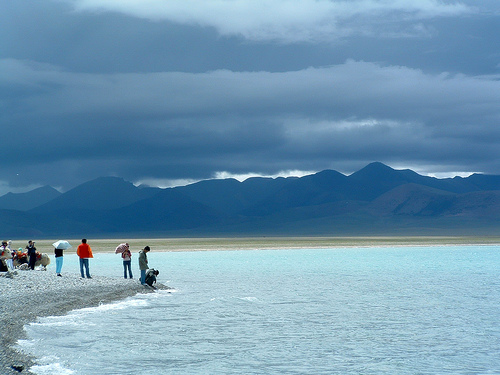
Lake Namtso, meaning “Heaven Lake” in the Tibetan language, is often described as being next to Heaven because of its lofty altitude, stunning beauty, pure blue water, and spiritual associations.--Snow-capped mountains and open grassland, dotted with yak herds and local nomads, surround the crystal clear waters of Lake Namtso, making it one of the most beautiful places in Tibet. 
Lake Namtso, the beautiful scenery of lakeside of Namtso, which is often described as being next to heaven.
Lake Namtso

Located northwest of Lhasa in Nagqu Prefecture, Lake Namtso is the highest salt lake in the world, with an elevation of almost three miles, or 4,718 meters. The lake also ranks the second largest salt lake in China, covering a vast area of over 1,900 square kilometers, or about 757 square miles. It is over 70 kilometers long, reaches a width of 30 kilometers and is 35 meters at its deepest point. 


The Striking Beauty of Lake Namtso

The scenery at Namtso is beautiful and magnificent. Mt. Nyainqentanglha standing to the southeast of the lake, soars to a height of over 7, 100 meters (23, 294 ft) above sea level, and is snow-capped throughout the year. The lake's northern side is bounded by gently undulating hills that form this part of the continental plateau. Melted ice and snow from the surrounding mountains are the major source of the pure and clean waters of this placid lake which has a typical emerald hue due to the high mineral content. 
Mt. Nyainqentanglha, stands to the southeast of the lLake Namtso.
Mt. Nyainqentanglha

Encircled by vast grasslands, the lake resembles a huge mirror. The lakeside plain provides a natural pasture where herdsmen graze their cattle and sheep. Here too is an abundance of wildlife that includes birds, ducks, bears, yaks, donkeys, blue sheep, foxes, river deer and Himalayan marmots, while the lake teems with fishes and is a source of precious medicinal materials. Numerous mani stones and colorful prayer flags can be seen all around the shore and these add another touch of brilliance to the scenery. 

The azure blue sky dotted with white clouds, the greenish lake water, and white snow, swathes of green grasses, red mani stone piles, multicolored flowers enhance the beauty of the area and together with the lively animals form a picturesque view of nature. 

It is small wonder that visitors had been to the lake say that they enjoy spiritual refreshment and a heart gladdening feeling when they stand beside Namtso.  


Lake Namtso--Holy Lake

There are four monasteries at the four compass points of Lake Namtso, and on the walls of these monasteries there are many rocky Buddhist artifacts carved out by nature. Lake Namtso is said to be the mother of Nyainqêntanglha Peak. 
Sunrise of Lake Namtso, the striking beauty of Lake Namtso.
Sunrise of Lake Namtso

At the end of the twelfth century, eminent monks of the Tibetan Kagyu school of Buddhism came to Namtso to practice their religion. They considered that this lake was the seat of Chakrasamvara of Esoteric Buddhism and they pioneered the practice of circumambulation around the lake. Later, Buddhists came to believe that during each Year of the Sheep in the Tibetan calendar, Buddhas, Bodhisattvas and Vajras assemble at this place. 

They also believe that during these auspicious occasions the chanting of scriptures and making a circumambulation of the lake is equal to doing them ten thousand times at other times. So each April to June in the Year of the Sheep, numerous pilgrims trek many miles from all over Tibet and other provinces, such as Qinghai, Gansu, Sichuan and Yunnan as well as from India and Nepal. It takes twenty to thirty days to circumambulate the lake just once so today most of the people walk around an islet of the lake instead. 

During the Year of the Sheep, believers would come in large numbers at the end of winter, walking over the lake's frozen surface and carrying their food with them. They would spend the summer at Lake Namtso unable to return again until the water froze the following winter. Worshipers believed that if one walked around the lake once during the Year of the Sheep, he and his family would be blessed with good health, safety, knowledge and other virtues. --Though the practice of walking across the frozen lake is no longer permitted by the Chinese government, modern believers can worship at the Tashi Dor temple, which is built on the southeast corner of Lake Namtso. 


Travel Tips for Lake Namtso
Scenery of Lake Namtso, visitors appreciate the beautiful scenery of Lake Namtso.
Scenery of Lake Namtso

Traveling to Lake Namtso may require visitors to endure rough weather and high altitude but once they arrive there and take in its pristine beauty, the trip is a worthy and unforgettable experience. 

The best season for visiting Lake Namtso is summer, from May to September. However, visitors should come prepared at all times for wet weather, snow, and cold winds. October often brings heavy snowstorms and treacherous road conditions. 

There are tours available to Namtso from Lhasa or tourists can hire a taxi or mini bus from Lhasa, which is about a four-hour drive. 

Do you want a spiritual refreshment right now?—along these days, the quiet of mind is the most needed thing of modern people. If you are stressed, if you are disappointed, if you are searching for a pure world, then come to Lake Namtso to feel the natural world here to calm everything down and then be a stronger person to face the difficulties in life with strengths.—I believe, everything will be seen easy as you enjoy yourself in nature.

Thursday, January 17, 2013

Joyous Harbin IV: Harbin’s Landmark--St. Sophia Church

Mentioning of Harbin,you may think of the International Ice and Snow Festival and the Yabuli International Ski Resort have been talked about in the last articles. And, the Harbin’s Landmark-St. Sophia Orthodox Cathedral, which will be talk about in the chapter, you may be interested in it.

                                                                  Chapter Four


         Harbin’s Landmark--St. Sophia Church

St. Sophia Orthodox Cathedral in Harbin is one of the most splendid buildings in northern China and it is the largest Eastern Orthodox Church in the Far East. The church is located on the corner of Toulin Street (Toulin jie) and Zhaolin Street (Zhaolin jie). It is 53.3 meters (175 feet) high and occupies an area of 721 square meters (0.18 acres). In November, 1996, it was listed as one of the Key Cultural Relics under State Protection. 

St. Sophia Church: Yesterday & Today

St. Sophia Church has a complex history. It was built and completed in March, 1907 as part of a plan to reconsolidate the confidence of the army by building an imposing spiritual symbol. In 1921, Harbin had a population of 300,000, including 100,000 Russians. The church was expanded and renovated from September 23, 1923, when a ceremony was held to celebrate the laying of the cornerstone, to its completion on November 25, 1932, after nine years. --The moment it was finished, it had been the landmark of Harbin by its grand and magnificent appearance and exotic atmosphere.
St. Sophia Church, the appearance of the St. Sophia Church which is the Harbin landmark.
St. Sophia Church

By the 1990's, St. Sophia had undergone considerable decline. The church no longer was in use, and residential apartments and office buildings surrounded it. Magnificent Russian painted murals that adorned the church's arched walls were destroyed out of recognition. 

While in 1997, the local government under took to undo the decades of deterioration. But as the original Russian murals were lost completely, they were replaced by topically new murals depicting the architectural history of the Harbin community. And crosses that were removed in six places were replaced. Now, the murals, pendent lamps, dome and the bell tower are restored to their original splendor.

At present day, St. Sophia Church was hailed as a monumental work of art and the largest Orthodox Church in the Far East. It’s now an art gallery, displaying the history, current situation and future of this famous cultural city of Harbin with over 1000 pictures. --It is a popular tourist spot in the city attracting visitors home and abroad as well as a key historical site for the research of modern history of Harbin. 

St. Sophia Church: Architectural features & Adornments

The Byzantine style church is so beautiful, it is said to look as if it had been made by God's hands. In fact, St. Sophia means 'God's wisdom'. Under the bright sun, the church and the square area it lies on looks quite like the Red Square in Moscow.

Inner of St.Sophia Church, the beautiful inner of St.Sophia Church.
Inner of St.Sophia Church
The church was beautiful designed and decorated both in exterior and interior. The splendid church is designed to be a cross-shape in the east-west direction and its walls are covered by red bricks. It is a master-slave layout that a big green Byzantine spherical pinnacle commands four smaller tent-shaped pinnacles in typical Russian style. 

There are four floors and each is accessible by a door in the four respective directions. The top part of the main entrance is the bell tower houses 7 bells of totally different sizes and tones, the biggest one of which was molded by bell metal with a diameter of 1.425 meter and weight in 1.8 ton. In the middle of the bell, there are four saints. On every major feast day in the past, the well-trained bellman would tie the ropes of the 7 mallets to different parts of his hands and feet to play musical progressions. It is said that the clangs can resound to the skies and people even in dozens of kilometers away can hear it. 

Though the interior decorations and the gorgeous Russia painted murals were damaged because of wars and time, the architecture is still beautiful and spectacular as it used to be. The government has refurbished it and new murals were readorned depicting the architectural history of Harbin community. 

--All in all, St. Sophia Church is worth of traveling. How can you leave Harbin without visiting its landmark? The art of the church will really attract your interests and let you appreciate the real Russian style. Dears, what’s your affection of St. Sophia Church?

Tuesday, January 15, 2013

Joyous Harbin III: Fun on Ski: Harbin Yabuli International Ski Resort

In the last article, we have talked about the Harbin International Ice and Snow Festival, one of the pageants in Harbin in winter. Have you been there? Now, whether you have enjoyed it, there is another entertainment you must can not miss-Harbin Yabuli International Ski Resort.

Chapter Three


   Fun on Ski: Harbin Yabuli International Ski Resort

The Yabuli International Ski Resort, the biggest and best ski resort in China, is 200 kilometers (124 miles) east of Harbin and 120 kilometers (75 miles) west of Mudanjiang in Shangzhi City, Heilongjiang Province. 

The resort provides great skiing with high mountains and good snow. Local skiers enjoy the high elevation and the fact that the snow is neither too hard nor too powdery. The lowest temperature is -47.2°F. Because of the high elevation, snow falls for a long period of about 170 days. The period from November to late March of the next year is the best time to ski at Yabuli Ski Resort.

The resort is the biggest training centre for alpine skiers and the mountain hosts of many professional skiing competitions. In 1996 the 3rd Winter Asian Games was held here along with numerous the National Winter Games and other national and provincial competitions.
Yabuli International Ski Resort, people are skiing in the biggest and best ski resort in China.
Yabuli International Ski Resort

The ski resort includes two distinctive areas: the competitive section and the leisure skiing section. The alpine competitive skiing section reaches an altitude of 1,374 meters (approx. 4,508 feet). Built according to international standard, this section provides an excellent environment for professional skiers. In the leisure skiing section, the highest altitude is only about 1,000 meters (approx. 3,281 feet), and the area provides a comparatively safe environment for leisure skiing. 

There is also a German built slide where tourists can enjoy sliding down from the top of the snowy mountain. Doing skiing on the slide is easy and safe, bringing visitors a thrilling experience.

Besides skiing, visitors can also take advantage of the other entertainment facilities at the resort, such as the mini golf course, tennis court, turf courts, hot-air balloons, para-gliders among others. The combination of activities, the beautiful forest and comfortable facilities offer tourists a relaxing and fun vacation. In winter, the ski resort is a fantastic place for skiers; in summer tourists can escape the heat and enjoy fun outdoor activities. All year round the resort offers beautiful scenery.

Xin TiWei Resort, one of the two main resorts worth visiting.
Xin TiWei Resort
Basically, there are two main resorts worth visiting, Sun Mountain and Xin TiWei. The two mountains are literally side by side, and equally tall, but Sun Mountain is by far the better of the two. Some websites may tell you that TiWei is the best, but this is simply not true. TiWei is considerably cheaper, but you will not regret the extra expense of Sun Mountain.  

Sun Mountain has far better rental equipment, more trails, a better snowboard park, nicer facilities, better service, and better snow. Beginners may saving money at TiWei, but experienced skiers/boarders should head directly to Sun Mountain. Sun Mountain even has English-speaking trainers available. Sun Mountain is affiliated with Club Med hotel, but you don’t need to be a hotel guest to ski there.

At TiWei, if you’re an experienced skier/boarder, be sure to specify that you want the “advanced ticket”.  Beginners can pay a lower price, but you are limited to only the bottom portion of the mountain. There is accommodation available at all price ranges.    

Facilities of Yabuli Ski Resort

Yabuli Ski Resort has 6 snow-grooming machines that ensure an optimal powder consistency on the surface of the various pistes at all times, another factor that puts this particular ski resort in a class by itself. The skiing season at Yabuli Ski Resort begins in mid-November and runs until the end of March. 
Ski Runs, the overview of the Yabuli ski runs.
Ski Runs

Yabuli Ski Resort has 9 intermediate- to advanced-level Alpine pistes, a 5-kilometer Nordic trail and a 500-meter gentle Alpine slope for beginners. The resort's prime advanced-level Alpine piste measures some 3 kilometers (3000 plus meters) with a vertical drop of an impressive 805 meters, which makes this the longest – and most exhilarating – Alpine ski piste in all of Asia (it should be noted that the ski resort is divided into a competition and a leisure section, the former being restricted to domestic and foreign professional (i.e., national-team) skiers). 

The ski resort employs more than half-hundred ski instructors, and though not all of the ski instructors are fluent in English, they are all reputed to be knowledgeable, and very thorough in their tutoring. 

The resort has 9 ski lifts, more than enough to ferry skiers to their various destinations without having to wait in long queues. Visitors say that the old adage about 'getting there being half the fun' has never been more true than in the case of the trip up Yabuli Sun Mountain in one of Yabuli Ski Resort's ski lifts: the views are spectacular as the visitor ascends alongside ridges and ravines, looking out over a forest of snow-clad trees.

Accommodation on Yabuli Ski Resort

Windmill Village, one of the 3-star hotels in Yabuli.
Windmill Village
Yabuli Ski Resort is a hyper-modern facility with all that the visitor can desire in the way of bars, restaurants and lodgings, as well as in the way of ski and other winter-sport rental facilities. Besides catering to skiers, the resort has facilities for snowboarding, ice skating and tobogganing – in fact, Yabuli Toboggan Run is the world's longest. 

The ski resort incorporates a number of hotels and bed & breakfast establishments with, in all, over 600 beds. Even cheaper accommodations can be found in the town of Yabuli itself. The ski resort's two 3-star hotels, the Windmill Village and the Tinyihu, have between them some 300 beds. These two hotels offer all the latest conveniences, from indoor swimming pools to fitness rooms and billiard halls to Internet cafés, bars, gift shops, restaurants, play rooms for kids – even a full-sized bowling alley – and the hotel rooms naturally come equipped with cable TV.

In the off-season, from late spring to autumn, there are a number of other activities on offer at Yabuli Ski Resort such as "grass skiing", tennis, mini-golf, hot-air ballooning and para-gliding, and then there is the stunning nature of Yabuli Sun Mountain itself, as well as that of the greater Changbai Mountain Range, where the stealthy visitor just might be lucky enough to spot bears, deer, leopards, tigers and wild boars, while just about every visitor will run across hares, pheasants, squirrels – and birds, birds, birds – not to speak of the chance, after-dark spotting of a badger.

Travel Tips on Yabuli Ski Resort

1. Weather condition in Yabuli: Yabuli's winter weather and large amount of snowfall has resulted in the best snow quality in China. The lowest temperature in winter is 44 degrees below zero and the average temperature is 10 degrees below zero. The average snowfall is 20-50cm at lower part of the mountain, 100cm at the top of the mountain. Ski season in Yabuli begins from the middle of November and ends in late March.

2. Protect your skin from the sun and wind. Winter is not only cold but harsh and brutal to your skin. Add up wind, cold weather and UV rays that reflect off the white snow back onto your face. Take hot shower however take it for short periods only as it tend to take away the natural oils and lipids from the skin's surface leaving it dry as bone. Bring some oily skin care products would be very useful.
Enjoy Your Happy Family Times, go to Yabuli with your family.
Enjoy Your Happy Family Times

3. Opening Hours: Daily, 08:00-16:30 (from November to March) The opening time for the ski resort is from 8:00am to 4:30pm(depending on the weather condition on the day). Normally it is getting dark around 4pm to 4:30pm. It is highly suggested that you get up early in the morning to enjoy skiing and then get your lunch around 1pm and have a rest in the afternoon.

4. How to get the Yabuli: There is no airport around Yabuli Ski Resort. Harbin and Mudanjiang are the two nearest cities with airports connecting major cities in China. Harbin Taiping International Airport is about 45 kilometer from downtown area Harbin, you can take the shuttle bus for about 50 minutes from the airport to Harbin train station and take train to Yabuli.

--By Bus: There are a number of tourist trains daily to the resort from Harbin, taking about 3 hours. After arriving at the town, mini tourist buses will transfer you to the tourist resort.

--By Train: To reach there, via public transportation, you can take D61, D63, T479 or T481 train from the Harbin Train Station to the Yabuli Train Station. Once at the train station, take a bus to the skiing resort. There are two railway stations in Yabuli - Yabuli Railway Station and Yabuli Railway South Station. Yabuli Railway Station is located in Yabuli Township while Yabuli Railway South Station located at Yabuli Ski Resort. 

5. Food in Yabuli: The food in Yabuli ski resort in limited, most of them are available in the hotels only. However you can also taste original northeast food at some local restaurant providing local vegetables and meat such as deer meat hot pot, typical northeast China dumpling, sliced pork, sour cabbage and rice noodles. 

--In a word, thrilling Harbin Yabuli International Ski Resort is an ideal place to experience stimulating activities on the ski. This special kind of sport will give you a memorable exciting experience in a beautiful white snow world!

Monday, January 14, 2013

Joyous Harbin II: 2013 Harbin International Ice and Snow Festival

In the last article, we have talked about the overview of Harbin, I think you should understand something about the ice city. And now, there is a solemn festival is held in Harbin-the 29th Harbin International Ice and Snow Festival. Come on and enjoy the ice  fairyland.

                                                           Chapter Two


2013 Harbin International Ice and Snow Festival

Time: January 5th-Febuary 5th, 2013   
Place: Harbin, Heilongjiang Province, China
Main Exhibition Areas: Sun Island & Ice and Snow World & Zhaolin Park
Activity: fantastic and artistic ice-lantern show, great fun of varied games with ice--ice-skating, sled-playing, ice-boating, winter-swimming, etc.

Harbin, the capital of China's now-frozen northeastern Heilongjiang province is holding its annual International Ice and Snow Festival. The Harbin festival is one of the world's four largest ice and snow festivals, along with Japan's Sapporo Snow Festival, Canada's Quebec City Winter Carnival, and Norway's Ski Festival.

Harbin is located in Northeast China under the direct influence of the cold winter wind from Siberia. The average temperature in summer is 21.2 degrees Celsius, -16.8 degrees Celsius in winter. Annual low temperatures below -35°C are not uncommon.
Overview of the Ice World, the beautiful night scenery of the Harbin International Ice and Snow Festival.
Overview of the Ice World

With a 190-day freezing season, the northeastern city of Harbin is known as a "City of Ice" and a cradle of the ice-and-snow culture in the world. The long and frigid winter, and the high plasticity and hardness of ice blocks quarried from the Songhua River, furnish favorable conditions for ice and snow sculpture. 

On January 5, 1985, the first Harbin Ice and Snow Festival were unveiled. Since then it has become an annual event from January 5 - February 5, which is highly acclaimed around the world. 

Harbin's annual ice festival is now in its 29th year. The festival features ice and snow carnival; international ice sculptures competitions in the Sun Island; ice lantern exhibition in the parks; speed skating, cross-field skiing and Alpine skiing competitions in the Yabuli Ski Resort or other famous ski resorts; fishing on the icy lakes and rivers; winter swimming in the Songhua River; ice and snow film art festival; exhibitions of paintings, calligraphy and photos; performances of folk songs and dances; wedding ceremonies on ice; economic and trade talks; commodities fairs and trade fairs etc.

The "Harbin International Ice and Snow Festival" is known as one of the most important tourist highlights in China. For years, it has been a Mecca for thousands upon thousands of world's tourists.

For instance, Zhaolin Park, one of the major venues for the festival, is turned into a Disney wonderland with ice sculptures of Mickey and his friends from classic Disney animation films. You can take a tour around the ice castles of Sleeping Beauty and have fun sliding down from the top of Aladdin's tower. 

One-day Fun of Ice and Snow Festival

From the city, there are several ways to get to the festival. If you are trying to do everything in a day, start with lunch and a stroll along Zhongyang Dajie. This pedestrian-only street is the heart of the city's Russian legacy, with interesting shops and food.

Ice Sculptures Castle, the beautiful ice sculptures in Harbin International Ice and Snow Festival.
Ice Sculptures Castle
An hour in the Ice and Snow World leaves most travelers chilled to the bone. A dinner of hot pot can never seem more welcome. Cai Zhen Ji hot pot restaurant serves up the style and selections of Beijing's Ding Ding Xiang, but at second-tier city prices. When in Rome, do as the Romans do. So, when in Harbin, remember to order plenty of Harbin Beer and baijiu for endless rounds of toasts with friends.

About three blocks to the east is the Church of St Sophia, a lovely red-brick Russian Orthodox landmark with a distinctive green "onion" dome. The inside is now an architecture museum.

While there is still daylight left, take a quick taxi ride across the Songhua River to Sun Island Park. Go to the snow sculpture park first and see the huge and amazingly life-like reproductions of folk musicians, heroes of China, including Mao Zedong and Zhou Enlai, temples, gates, archways and other structures big enough to step through and explore. 

Then at twilight, head for the ice venue. At night the ice park glitters in colored lights like a kaleidoscope, and visitors can skate, play hockey or watch a figure-skating show as well as gawk at the huge ice city.

When night falls, a winter wonderland comes to life. The main attraction this time of the year is the Ice and Snow World, where ice sculptures are set across a large park area just north of the Songhua River. Giant blocks of ice are farmed from the river, hauled to the site, and built into world landmarks familiar to the frequent traveler.

When you have tired of gaping at the sculptures with awe, or of rubbing your hands and stomping feet to stay warm, head to the many igloo tea shops scattered around the park. Other attractions include ice slides several stories tall, dance and music shows, and cheesy photo ops with snow foxes.

Besides, winter swimming has been a longstanding Harbin tradition, drawing many enthusiasts who rave about the health benefits of polar plunging into -30°C waters. The less adventurous can stand on the sidelines and watch as middle-aged swimmers strut their stuff on the frozen surface of Songhua River before diving off a platform made of, you guessed it, blocks of ice.

Exhibition Place 1: Sun Island Park

Sun Island Park covers 15 square kilometers and is featured by cultural attractions and natural landscapes. Sun Island Park consists of one big island and some smaller islands in the Songhua River, which meander through the north of Harbin. It covers a total area of 3,800 hectares.
Sun Island Park, the picturesque cultural attraction and natural landscapes.
Sun Island Park

In summer, the island serves as a natural river beach swimming resort and sanatorium area. The island boasts several fine beaches on either bank, such as a profusion of lakes for boating, swimming pools, sunbathing facilities, a fairground, a water world and an arms museum. The middle and northern part of the island is composed of mainly forested areas and a large garden.

Various differently styled recreational buildings were built around the “Sun Lake” and the "Lotus Pond". With hidden paths winding throughout, the park is a nice area to stroll and get away from the crowds, being lushly vegetated with trees and flowers. Barbecues and picnics can also be arranged in one of the meadows here. During winter, the Sun Island is used as the playground for various winter sports; Skiing, Hockey, Ice-skating, and Sledding games. What is more important, the renowned annual Snow Carving Festival is held here.

 Exhibition Place 2: Harbin Ice and Snow World

First set-up by the Harbin Municipal Government in 1999, Harbin Ice and Snow World is by far the largest ice and snow art exhibition in the world. It is commonly referred to as possessing four of the key 'mosts': the most art attractions, the most beautiful night views, the most recreational activities and the most forms of entertainment. Furthermore, the festival is constantly evolving and each year brings with it a new theme, providing visitors with a totally unique experience from one year to the next.

Beautiful Moon, the attract beautiful sculpture moons on the castle.
Beautiful Moon
The ice carvings at the Ice and Snow World are regarded as some of the world's finest examples of ice art, with visitors able to admire some of the largest and most majestic ice-sculpted masterpieces. Each of these ice carvings is designed in some way related to the festival's theme, enabling travelers to sample a variety of cultural flavors. 

For example, in its first year the festival's layout was designed around the idea of 'Prosperous China and High-flying Longjiang', with the ice carvings depicting the rapid development of the country. In 2005, the theme was 'Friendship between China and Russia', with all the sculptures fashioned in a typical Russian style. Among them were replicas of some of Russia's most famous architecture, such as the East Palace, and Moscow's Red Square.

One of the highlights for any visitor to the festival is to visit the site at night when multicolored lights set underground illuminate the sculptures, revealing a whole new colorful dimension to the exhibits. The contrasts of the bright and dazzling lights against the dark night sky make the works look all the more spectacular.

The Ice and Snow World is also a centre for various forms of recreation and entertainment, with a variety of opportunities on offer. Visitors will be amazed by the magnificent ice buildings, including an ice maze, ice bar, and even an ice hotel. If you are a fan of snow sports, then there is also the chance to participate in activities such as ice rock-climbing, skating, skiing, sliding, snow fights, ice golf, and ice archery. 

Exhibition Place 3: Harbin Zhaolin Park

Harbin Zhaolin Park was situated in the busy center of the city, faced on to a street along the beautiful Songhua River bank. 

Under unique climatic conditions, Zhaolin Park has two characteristic natural scenes in summer and winter. In summer, the pleasant outlook is composed of flourishing greenery and fragrant-grass, while flowers in full blossom competing with each other for beauty of looks.  The small gardens in it have unique styles, such as "northern garden", "reflecting-moonshine garden", "southern greenhouse", "clove garden", luring you with their charming and beauty. 
Zhaolin Park, the attract night scenery of the world of ice lantern.
Zhaolin Park

In winter, Zhaolin Park is a world of ice lantern. The world-famous ice lantern garden party is held here every year for many times. When night falls, the resplendence and multicolor of ice lanterns are full of the whole park. The vivid and peculiar ice lanterns are adopted by modern technologies, such as sound, light and automation. 

The design of ice lanterns includes the beautiful sceneries in the world and modern and ancient marvelous spectacles. Placing yourself in such a supernatural ice-snow world, you will enjoy yourself so much as to forget to leave. Millions of visitors are attracted to this garden party by its reputation as a scenic spot: they enjoy the marvel and magnificence of ice-and-snow in the north of China, as well as, in a fairyland. 

Sunday, January 6, 2013

Joyous Harbin I: White Snow World of China: Harbin

Harbin, the capital and largest city of Heilongjiang Province in Northeast China, is known for its bitterly cold winters and is often called the "Ice City" and is notable for its beautiful ice sculptures in winter and its Russian legacy. In 2010 it was declared a UNESCO "City of Music". Hey, it's winter now, I am sure it should be very happy in Harbin now. Are you exciting? We will show you the overview of Harbin in the chapter.

Chapter One


                   White Snow World of China: Harbin

As the political, economic, scientific, technological and cultural center - and not to mention, the transportation hub - of Heilongjiang Province, Harbin is located on the eastern Song-Nen Plain and on the right bank of Songhua River. Harbin is a famous international metropolis blending Western culture and Eastern culture perfectly. It is also called "Paris in the Orient", and "Moscow in the Orient". 

It is one of the sources of ice and snow culture in the world. Geographically, it is located in Northeast China under the direct influence of the cold winter wind from Siberia. The average temperature in summer is 21.2 degrees Celsius, -16.8 degrees Celsius in winter. It can be as cold as - 38.1 degrees Celsius in winter. 

Fun in Harbin

Special historical processes and a favorable geographical position created Harbin a beautiful city, touched with a hint of exoticism: it brings together the histories and cultures of northern minorities and assimilates Russian and Eastern European flavors as well. 

Harbin TV Tower, known as Dragon Tower by local people.
Harbin TV Tower

Harbin has lovely scenery and distinct seasons. Sun Island, the Siberian Tiger Park, Stalin Park, Erlong Mountain Scenic Spot, Yuquan Hunting Centre, Zhongyang Street, St. Sophia Cathedral, the Confucian Temple, and the Jile Buddhist Temple are famous tourist resorts. 

Besides, the city has the world-renowned "Harbin Summer Concert" and the Harbin Trade Fair held annually. Endowed with a frigid climate, Harbin also boasts many attractions for winter tour, such as the high mountain skiing resorts in Yabuli and Erlongshan, Ice Lantern Fair at the Zhaolin Park, the winter swimming on the Songhua River as well as the Harbin International Ice and Snow Sculptures Competition held every year.
Festivals in Harbin

Harbin Ice Lantern Festival, the beautiful night scenery of Harbin Ice Lantern Festival.
Harbin Ice Lantern Festival

Harbin Ice Lantern Festival: The Harbin Ice Lantern Festival is Harbin's main claim to fame these days. Every January, Zhaolin Park and the banks of the Songhua River, as well as Sun Island Park, become home to extraordinarily detailed, imaginative and downright wacky snow and ice sculptures. Tourists can enjoy many kinds of fantastic and exciting activities like skiing and winter swimming during the festival.

They range from huge recreations of iconic buildings, such as the Forbidden City, to animals and interpretations of ancient legends. At night they're lit up with colored lights to create a magical effect.

It might be mind-numbingly cold and the sun disappears mid-afternoon, but the festival, which also features figure-skating shows and a variety of winter sports, is Harbin's main tourist attraction - and prices jump accordingly. Officially, the festival gets going on 5 January and runs for a month, but it sometimes starts earlier and often lasts longer, weather permitting.
Harbin Summer Music Concert, the opening gala of the Harbin 31th Summer Music Concert.
Harbin Summer Music Concert

Harbin Summer Music Concert: it is a national concert festival, which is held on August 6 every two years for a period of 10~11 days. During the concert, multiple evenings, concert, race and activities are held. The artists come from all over the world. The 'Harbin Summer Music Month', which was then renamed as 'Harbin Summer Music Concert', was held in August 1958. The first formal Concert was held on August 5, 1961 in Harbin Youth Palace, and kept on every year until 1966 when the Cultural Revolution started in China. In 1979, the Concert was recovered and from 1994, it has been held every two years. In 2008, the 29th Harbin Summer Music Concert was held on August 6.

Tasty Feast in Harbin

Harbin has a diverse and rich dining culture, with years of culinary development from the Jin and Yuan dynasties, local delicacies from the mountains and the products of multiculturalism in modern times. 


Xiaoji Dun Mogu, called stewed chick with mushroom in English.
Xiaoji Dun Mogu
Influenced mainly by local people, minority cultures, and Russian style, Harbin food features the following two characteristics: firstly, traditional Harbin food uses the cooking methods of steaming, braising, grilling, roasting and stir-frying. The taste is slightly salty compared to Cantonese Cuisine. 

Dishes are based on local delicacies from the mountains. Recommended dishes include Pa Qietiao (grilled eggplant with honey miso sauce and sesame seeds), Xiaoji Dun Mogu (stewed chick with mushroom), Zhurou Dun Fentiao (braised pork with Vermicelli) and Jiang Gujia (braised spare ribs in brown sauce). Dumplings from Northeastern China can not be missed. 

Secondly, Harbin’s dining culture became more multicultural with influences from Russia, Italy, France and Denmark. Russian bread, sausage, cheese, and cornichon are all popular western style foods in the city. Authentic Russian style restaurants can be found on Central Street and nearby.


Nightlife of Harbin

Nightlife in Harbin frankly is a little disorganized: but it is more permissive, more relaxed and more colorful than daily life. Harbin’s young generation, like young people in any other city, spend their evenings searching for release. They are the producers and actors of excitement. The most popular night venues for young people include bars, KTVs, and cinemas. Harbin people are generally good at Russian songs and most of them can seriously and emotively sing one or two of these. 

Er Ren Zhuan, is a local kind of lively folk art.
Er Ren Zhuan

But if you prefer quiet places, where you can talk and relax, perhaps a café is a better option. Older people might like to dance for exercise in the square or in the park. But if you are not interested in any of these activities, just go to the Liu Laogen Grand Stage and enjoy the drama of Er Ren Zhuan, a local kind of lively folk art. Central Street is considered the most popular street for bars in Harbin. Many unique bars and pub are scattered there.


Top 10 Things to do in Harbin


1. St. Sofia Orthodox Church: the largest orthodox church in Far East Region.

2. Central Street: it is a rare architectural art corridor in China. It is also one of the longest pedestrian streets in Asia.
St. Sofia Orthodox Church, is the largest orthodox church in Far East Region.
St. Sofia Orthodox Church

3. Ice & Snow World: A large-scale ice and snow theme park with ice and snow artistic landscapes, entertainment activities, ice lanterns and night views, etc. It is one of the world's largest ice architecture parks.

4. Sun Island: Lying on north bank of Harbin Songhua River, the Sun Island is elegant and well-known with a melodious song of on the Sun Island.

5. Yabuli Ski Resort: The largest world class tourist ski resort in China which gives you an unforgettable winter holiday.

6. Jile Buddhist Temple: the biggest Buddhist temple in the northeast area of China. It is the place for Buddhists worship.

7. Summer Music Concert: it is a national concert festival, which is held on Aug. 6th every two years for a period of 10 to 11 days.
Velvet Antler, is a mainstay of traditional Chinese medicine.
Velvet Antler

8. Harbin Beer: Harbin Beer should be the earliest beer brand in China and it is still popular all over the country.

9. Ginseng and Velvet Antler: Harbin is near Great Khingan and Mt. Changbaishan. Quality ginseng and velvet antler are notable local products.

10. Ice Lantern: Zhaoling Park is an ideal place to appreciate the colorful and crystal ice lanterns. It’s one of the most popular parts of the Harbin International Ice and Snow Festival is the ice lanterns and sculptures found in Zhaolin Park.

Dreamed of a pure white snow world? Raising interests from my description of this great winter glamour city? Why not come to Harbin in winter to experience it all? Playing in the world of snow will be great and romantic that let you forget about cold weather. In a world, Harbin will be your best choice to enjoying a winter trip in China.