Thursday, November 29, 2012

Memory of Shanghai VIII: Shanghai French Concession

Remembered as the famous ladies of old shanghai, shanghai french concession is one of the impressive memories of Chinese. What was it and what is it now? We will talk about it in the chapter.

                                                       Chapter Eight


                                       Paris of the East --Shanghai French Concession

The French Concession was the earliest, biggest and most prosperous Concession in Shanghai. It’s also known as French town which was a former foreign concession in Shanghai during the period of 1849 to 1946.

Shanghai French Concession is in old-Shanghai romance with the convenience of downtown living which stretching from Yanan Lu (road) in the north, Zhaojiabang Lu in the south, Huashan Lu in the west and Xizang Nan Lu to the east. With its peaceful, picturesque, tree-lined streets, this area retains an air of the "Paris of the East". At the same time, many of the small backstreets still have a very local feel. 

                                 Yesterday of Shanghai French Concession

The history of the French Concession is the history of foreign involvement in modern China. After the Chinese loss of the Opium Wars in 1842, Shanghai, among other cities, were forced to open themselves as international “ports of call.”
Old Shanghai, became a large center for foreign trade after he first Opium War
Old Shanghai

In the mid 19th century after the first Opium War, Shanghai became a large center for foreign trade and in 1849 the French Consul to China, Charles de Montigny signed an agreement with a senior local official to create a French Concession for French businessmen and traders to live. Over the next hundred years the area became home to many nationalities such as British, American, Russian and Chinese. 

Like the International Settlement, The French Settlement had its own code of laws and enforcement and was a de facto sovereign nation. Entrance by local Chinese was strictly limited to the affluent and influential and, in fact, many Chinese leftist artists and intellectuals made the French Concession their home. Nevertheless, the French ran their own municipal counsel and named all the streets after French generals, martyred soldiers, and other famous personalities. 

In the 1930s, Shanghai and the French Concession were at the height of their glamour and also decadence. Then it was also well known as center for brothels, gambling, and opium. During the second world war in 1943, a deal was made with the Chinese government to give control back to China along with French concessions in other Chinese cities, ending all French control in China. 

The occupation by western culture has given the area a wonderful mixture of both European and Chinese architecture. It may cause surprise to see old large European buildings in the middle of China's biggest city. 

                                    Today of Shanghai French Concession

Besides its historical and religious factors, today the area is still the most graceful part of Shanghai and a fantastic place for spending leisure time-- the most rewarding district for walks and bike rides. You can spend hours wandering the narrow alleyways, dining and one of the million cafes or restaurants, or browsing through the endless art galleries and photographic studios.
Today of Shanghai French Concession, is still the most graceful part and a fantastic place
Today of Shanghai French Concession

Actually, the French Concession today is one of the most popular places in Shanghai to visit. Especially popular with Shanghai's middle and upper class residents, a wealth of cafes, restaurants and shops will have you wandering the area for an entire day with ease. The most famous and wealthy area in the French Concession is Xintiandi, which is known for its Shanghai architecture, its art galleries, designer boutiques, cafes and eateries. The large choice of pubs and clubs at night will provide an entertaining time for all. 

Characterized by an intriguing mix of low-rise, architectural styles dating from the colonial-era, this area boasts quaint boutiques and galleries, an endless supply of stylish bars and restaurants, plus easy access to metro stations and Huaihai Lu, ' the hub of Shanghai' s shopping scene. To the south-west of the area are Xujiahui's mega-shopping and leisure malls. All these factors combine to make Xuhui and Luwan, the two areas proper that make up the French Concession, an extremely desirable, world-class lifestyle package.

                                    Sites in Shanghai French Concession

1. Site of the 1st national congress of the CCP: On 23 July 1921 the Chinese Communist Party (CCP) was founded in this French Concession building, propelling this unassuming shikumen block into one of Chinese communism's holiest shrines.

Sun Yat-sen drew up plans for a modern unified China and Mao Zedong helped to found the Chinese Communist Party. The site of the First National Congress of CPC is at east side of Xintiandi, Xingye Lu.

There is plenty of Marxist spin in the museum commentary, just in case you had forgotten that Shanghai is actually part of the world's largest communist country. There's not all that much to see here, but historians will appreciate the site as a defining moment in modern Chinese history.
Sun Yat-sen's Former Residence, is now a museum of Sun Yat-sen and his wife Soong Ching-ling
Sun Yat-sen's Former Residence

2. Sun Yat-sen's Former Residence: at 7 Xiangshan Rd. The house was the Shanghai residence of Sun Yat-sen and his wife Soong Ching-ling from 1918-1937. It’s now a museum which tells the story of the revolutionary father of China's republic. 

3. Zhou Enlai's Former Residence: at 73 Sinan Rd, Luwan District. It was the former Shanghai Office of the Delegation of the Communist Party in China from June 1946. It is now a museum telling the story of the Communist revolution in China and particularly Shanghai. 

--Are you ready to walking or cycling in Shanghai French Concession now? This “Paris of the East” is waiting for your discovery!

Monday, November 26, 2012

Memory of Shanghai VI: Nightlife in Shanghai

As a major financial center in the world, the nightlife in Shanghai is both notable and notorious. Besides walking on the Nanjing Road, there are many wonderful enjoyments at Shanghai's night. We will talk about the nightlife in Shanghai in this chapter.

                                                          Chapter Six

           Paris of the East—Nightlife in Shanghai

The nightlife in Shanghai is both notable and notorious. The "Paris of the East" is the bustling capitalist center of China's booming economy and the nightlife of the city offers every level of enjoyment from the sophisticated to the seamy. Shanghai is the most exciting city in China, and the nightlife in Shanghai shines as brightly as its skyline. 

Shanghai has been a city vigorous in colorful night life since 1930’s. At that time night life was upper-class people's privilege. Only the rich merchants and officials can go to night clubs to enjoy night life. Lots of rickshaws were waiting outside the clubs. Once performances in the clubs ended the owners of the rickshaws began to rush to their goals - the rich people who just ended their night activities. 

However, today almost every young adult can enjoy night life with their friends or lovers in bars, parks or cinemas and so on.--Because in the day, most Shanghainese lead a somewhat dull and conventional way of life, they rush to all kinds of innovative parties in the night. In a word, night life has become an indispensable part to people who live in Shanghai. Generally speaking, night life in Shanghai is rich, gentle and elegant.

The ways to enjoying nightlife in Shanghai are variable. Follow my steps of introduction to showing you wonderful enjoyments at Shanghai’s night.

1. Walking along the Bund: leisure & great sight-seeing

The Bund, one of the most famous tourist destinations in Shanghai
The Bund
Finish off the night with a walk along Shanghai's world-famous Bund area. Thousands of people come down to the river area to marvel at the European style architecture and contrast it with the spectacular views of the ultra-modern Pudong area across the river, which rises like a glowing neon science fiction cityscape. --Looking across the Huangpu River to the Oriental Pearl TV Tower and Jinmao Tower is a magical sight and a night-time Huangpu River cruise presents a wonderful opportunity to appreciate the night life on the Bund.

2. Taste Shanghai Snacks: delicious & mouth-watering

Shanghai snacks, many delicious snacks are offered in Shanghai
Shanghai snacks
No matter what type of cuisine you're in the mood for, there's undoubtedly a restaurant that caters your taste in Shanghai. Being the largest city in China, Shanghai obviously has much to offer in terms of Chinese cuisine. Anything from Cantonese cooking to Sichuan cuisine to local Shanghainese delicacies can be found just around the corner of any street in Shanghai. They are also incredibly cheap eats.

3. Shopping at Nanjing Road & Xintiandi: modern & one-stop 

Xiantiandi, is another ideal shopping area in Shanghai
Xiantiandi
Start a great night in Shanghai by visiting the fantastic Nanjing Shopping Street. The energy of the bustling pedestrian-only street wakes up the senses. There are over 600 shops with great deals all around. The charm and glamour of Nanjing Road at night will be your ideal place to experience metropolitan and world-class fashion.

Another ideal shopping area is the Xintiandi. In Xitiandi you will find it is a commercial center as well as an attractive spot. When you walk into Xintiandi, you will get the taste both of Shanghai in the 1920 and the sonic modern lifestyle of urbanites of the 21st century. In here, you can not only appreciate Shanghai architecture, the nightlife of Shanghai citizens also lies in its lanes.

4. High Passions in Shanghai Night bars

Babyface, one of the top notch nightclubs in Shanghai
Babyface
Bars play an important role in night life in Shanghai. Looking to dance the night away? Shanghai has you covered. Enjoy bar hopping in Shanghai. The city has hundreds of bars, pubs, discos and nightclubs. 

Check out Babyface on Huai Hai Rd. or Park 97 and Guandi in the middle of Fu Xing Park. These are all considered top notch nightclubs in Shanghai. The music is better than you will find anywhere else in Shanghai; everything is played from old school hip-hop to contemporary remixes to local favorites.

If you're looking for a place that's a feast for the eyes, check out Bar Rouge on the bund. This is hands down the most up-scale bar in Shanghai. Located on the 7th floor of Bund 18, it has one of the most spectacular views of the Huang Pu River.

5. Old entertainment ways of Shanghai Shine in new forms

The leisure and recreational activities in Shanghai feature rich content and new forms. There are not only traditional activities with the Town God's Temple as the center such as the Town God Fair and Lantern Fair, but also recreational activities with the combination of Chinese and Western styles such as Flower Drum Opera, circus show and horse racing.
Circus Show, one of the popular recreational activities in Shanghai
Circus Show

There are not only modern Karaoke, dance halls, bars and so on, but also elegant bowling, tennis, golf, fitness and entertainment centers and so on. There are not only ceramic bars, painting bars, weaving bars, toy bars and other highly participatory featured bars, but also all kinds of art galleries. As for operas, dance, music, acrobatics and films, they are the most important leisure and recreational activities for Shanghai people and tourists.

All these varied ways of entertainment can be find and enjoy at Shanghai’s night. Choose your own ways and no doubt you can spend wonderful nightlife in Shanghai. 

--Have you ever thought to experience the Shanghai nightlife when you plan to Shanghai? Have you ever known where to see the real nightlife in Shanghai? Have you ever got touch with the old and modern Shanghai at the same time? Just plan for a night wander in Shanghai as above recommended now!

Friday, November 23, 2012

Memory of Shanghai V: Sparkling Nanjing Road of Shanghai

In the last article, we have talked Yu Yuan, the beautiful garden in Shanghai. If you want to go outside and take a walk to experence the glamour of Shanghai, I strongly suggest that you can visit the Nanjing Road, which is introduced in the chpater about its history and current situation.

                                                       Chapter Five


                  Sparkling Nanjing Road of Shanghai

Shanghai's most famous thoroughfare, Nanjing Road stretches across the central city of Shanghai and next to Huangpu River in the east, the cross point of Jing'an Temple and West Yan'an Road. It is 5.5 km in full length, enjoys the reputation as China No. 1 commercial center. It was the earliest commercial street in Shanghai since the city opened to the outside world.

                                   Yesterday of Nanjing Road

Nanjing Road enjoys a history of over 100 years and used to be called “Parker Lane”. It was named Nanjing Road officially in 1865 and turned into a pedestrian road in 1999. 

After the Opium War (1839-1842), Shanghai became a treaty port. Nanjing Road was first the British Concession, then the International Settlement. Importing large quantities of foreign goods, it became the earliest shopping street in Shanghai. -- A series of franchised stores were set up at that time. 

Eight big department stores were established along the street one after another. 

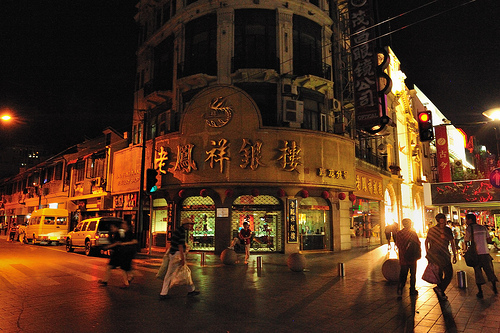
The Old Phoenixes, is the century old jewelry shop
The Old Phoenixes

1. The Old Phoenixes (老凤祥): It was created in 1848, and it is the only century old shop that has been handed down for 1.5 centuries. The jewelry there is pretty well-known, especially the ornaments made from gold, silver and diamonds. 

2. Zhang Xiao Quan (张小泉): The scissors sold at this store can shear silk fabric without leaving any redundant silk: first, they are smooth in shearing cloth; second, they never rusts; third, on the handles of the scissors there are graphic patterns. All of the characteristics make people fondle them admiringly. 
Fresh pork moon cake, one of the characteristic in Lao Da Fang
Fresh pork moon cake

3. Lao Da Fang (老大房): Smoked fish and fresh pork moon cakes are the most characteristic there. The sugar sauce on the outside of the smoked fish tastes both salty and sweet, and is crisp both outside and inside. It is said that the moon cakes are made with a secret recipe handed down from the ancestors. 

4. Cai Tong De (蔡同德): The store was created in the first year of Guangxv of the Qing Dynasty (1882), which is an old and famous traditional Chinese medicine shop that was the earliest business to start and is the most large-scale. All along, it was an expert in producing and managing nourishing plaster and wine. 

5. Wu Liang Cai (吴良才): it specialize in various glasses of high qualities and also among the old and famous shops of old Shanghai on Nanjing Road. 
Shao Wan Sheng, sells the wine-preserved food of Ningbo and Shaoxing flavors
Shao Wan Sheng

6. Shao Wan Sheng (邵万生): The shop specializes in the wine-preserved food of Ningbo and Shaoxing flavors, and the most famous two are wine-preserved winkles and wine-preserved crabs. 

7. Shen Da Cheng (沈大成): All kinds of desserts and locally flavored snacks are sold there, among which, pastry balls are the most famous. 

8. Duo Yun Pavilion (朵云轩): The store mainly sells Chinese paintings and calligraphy, and relevant writing materials; the store’s woodblock printing and Beijing’s Rong Bao Room are famous respectively in the South and in the North. 

                    Today of Nanjing Road

Over time, Nanjing Road has been restructured, undergoing significant change. With the development of over one hundred years, the Nanjing Road becomes the must-see place of metropolitan destination attracting thousands of shoppers seek fashion here from all over the world as it also shows the bustling Shanghai with charm and glamour.

For shopping convenience, its eastern end has an all-weather pedestrian arcade. Big traditional stores no longer dominate the market since modern shopping malls, specialty stores, theatres and international hotels have mushroomed on both sides of the street. 

There are more than 360 malls, department stores, specialized shops, restaurants and cultural and recreational facilities. In the daytime, the street is crowned with visitors and when the night falls, flashing neon signs illuminate the magnificent buildings and spangle the night skyline of Shanghai.

No doubt, Nanjing Road is the most luxury street in Shanghai. Nanjing Street is a comprehensive shopping center which integrates tourism, business and culture together. The Pedestrian way of Nanjing Road where there is no crowded traffic but it is prosperous and elegant. You will feel pretty pleased when doing your shopping, relaxing and tasting delicious food there.

Below will recommend where and how to enjoy your wander in Nanjing Road.--
Ann department Store in Nanjing Road, a bustling place
Ann department Store in Nanjing Road

1. The "Golden Belt": the 4.2 meter wide "golden belt" is set 1.3 meters northward of the Nanjing Road axis. It runs through the whole pedestrianized area. There are urban public facilities such as seats, shopping booths, enquiry booths, signboards, small sculptures, street lights, trash boxes, parterres, telephone booths and so on. Every standard unit of the golden belt is 75 meters long and there is enough north-south walking space for tourists to run across the "golden belt" freely. 

2. The Manhole Covers: all of the 37 manhole covers on the "golden belts" were designed specially and everyone has different graphic patterns that are carved on it — each period’s embossments of the representative buildings and structures since Shanghai’s opening to the outside world, which are labeled with the building year and all of which are cast with gold and copper. The 37 manhole covers concentrate the development of Shanghai’s urban construction of over 100 years. 

3. Sculptures: on the "golden belt", there are three groups of sculptures made of casting copper, which are “a family of three people”, “young married women” and “the mother and the daughter”. All the sculptures used the proportions of real people and adopted the skill of realism. 
Nanjing Road in Day, another different scene of Nanjing Road
Nanjing Road in Day

4. A Different Scene: in many people’s opinion, a shopping street will always be full of crowds, material, commercial and modern. However, if you get up early and came to Nanjing Road in the morning, you will surprisingly find it total different scenery: shops along the street are all closed; only the dustman is busy with cleaning. In the street, the residents are dancing to the music, playing badminton, practicing Taichi, etc. It is more like a park rather than a shopping area. This is another charming side of Nanjing Road. 

Do you eager to go to wandering on this road now? --Standing in the center of Nanjing road at night to experience its bustle and prosperous while find out its old Shanghai atmosphere will be so great that you can never miss. 

Thursday, November 22, 2012

Memory of Shanghai IV: Yu Yuan Garden


In the last article, we have talked about the Bund, one of the famous attractions in Shanghai.In this chapter, we will show you another famous one to you, Yu Yuan, which is an extensive Chinese garden in Shanghai.                                              

                                                              Chapter Four

                            Beauty of Classical Chinese Garden—Yu Yuan Garden

Amidst the gray high rises of Shanghai lies an Oasis of greenery and ancient architecture. --that is Yu Yuan Garden which located next to Old City God’s Temple. In Shanghai, a saying goes as:" Those who have visited Shanghai but missed Yu Yuan Garden cannot claim that they have been to the city."

Yu Yuan Garden is the most famous classical garden with a history of more than 400 years. It is called garden "Yu Yuan", because "Yu" in Chinese means "peace and health"-- a place of peace and comfort in the heart of busy Shanghai.

This grand garden was built by the Pan family, powerful officials of the Ming dynasty. Built between 1559 and 1577 as part of their estate, this typical southern-style garden was destroyed several times and later restored to its former glory. Each pavilion, hall, stone and stream in the garden is expressing the quintessence of South China landscape design from Ming and Qing Dynasty.

There are 40 different scenes in Yu Yuan Garden which divided by dragon walls, wound corridors and beautiful flowers, form a unique picture featuring "one step, one beauty; every step, every beauty."-- the defining feature of the garden is the carefully created sense of space within small confines using narrow lanes, strategically placed partitions and windows that provide frames for portrait views. 

The 40 scenic spots scattered throughout the garden are divided into six parts by five boundary walls. The six scenic areas include the Grand Rockery, the Ten Thousand-Flower Pavilion, the Hall of Heralding Spring, the Hall of Jade Magnificence, the Inner Garden, and the Lotus Pool.


  • The Grand Rockery


The Grand Rockery, is one of the essences of the attractions in Yu Yuan Garden
The Grand Rockery
Being the oldest, the biggest, and the most exquisite rockery made of yellow stone in the south region of Yangzi River, the Great Rockery is one of the essences of the attractions in the garden. Moreover, the Great Rockery is the only piece of work left by its architect.


  • Hall of Heralding Spring 


Hall of Heralding Spring, is one of the main constructions in Yu Yuan garden
Hall of Heralding Spring
Built in 1760, the Hall of Heralding Spring was one of the main constructions in the garden. The name of the hall means good harvest and prosperity. During the time of Qing Dynasty, it was a place for the gathering of the local gentlemen.


  • Exquisite Jade Rock


Exquisite Jade Rock, is one of the three famous rocks in the southern region of the Yangtze River
Exquisite Jade Rock
The rock is one of the three famous rocks in the southern region of the Yangtze River. 3.3 meters high, the rock has 72 holes in it. If you burn a joss stick just below the rock, the smoke will magically float out from the holes. And when you pour water into the rock from top, the water will flow out from each hole.


  • The Inner Garden


The Inner Garden, is a beautiful part of the Yu Garden
The Inner Garden
The Inner Garden was a separate garden built in 1709. It is an independent part of the Yu Garden. 
Windows in gently curving walls reveal glimpses of corridors, ponds and streams. Dragons, dogs and elephants adorn eaves and the detail in paving stones and the deliberate placement of trees is extraordinary, yet a sense of the unplanned is somehow retained.

The pavilions and tiny halls house beautifully-carved heavy redwood chairs and tables. The stone garden (in front of the Hall of Jade Magnificence) is rated highly by experts. Even the fish are happy, as shown by the "Happy Fish Veranda" looking out over a delicately arched bridge. 


  • The Lotus Pool


The Lotus Pool, is the ideal place to enjoy the traditional Pingtan
In front of Yu Yuan Garden, there is a beautiful lotus pool. Across the pond is a zigzag bridge with a pavilion in the middle. The Mid-lade pavilion was rebuilt in 1784 and was later converted into a teahouse. This teahouse is a favorite place for old people, who enjoy chatting with each other over a cup of tea. 

Other fun of the teahouse is that it is the ideal place to enjoy the traditional Pingtan --a form of storytelling that traditionally has only one performer. The performer sits on the stage with only a couple of props used to emphasize what he is saying, and tells love tales, or tales of the daring exploits of legendary Chinese figures. 


  • Old City God Temple


Shanghai Old City God Temple, is one of the most popular scenic area nearby Yu Yuan Garden.
Shanghai Old City God Temple
Shanghai Chenghuanmiao, or Shanghai Old City God Temple in English, is a famous Taosim Temple in Shanghai area and one of the most popular scenic area as well as shopping center nearby Yu Yuan Garden. 

The prosperous Shanghai is decorated with blazing buildings and colorful young ladies. If you want to explore the old Shanghai, Old City God Temple will be the exact place for you to find the 100-year-ago Shanghai here.

In this street, the traditional Chinese buildings are with white walls and black roofs. Moreover, the people, the hanging red lanterns, the ancient memorial arch, all of these form into a picture that describes the old Shanghai.

Besides, there are lots of famous Shanghai local snacks in Chenghuangmiao Old Street. The special dim sum in Lubolang Restaurant, the vegetable Chinese bum in Songyuelou, the Babao rice meal in Songyunlou, and the Nanxiang Chinese bum, all of these can be found in the old street.

-- Actually, although old place of old Shanghai, people can still have new and thrilling ways of entertainment there. Why not wander in Yu Yuan Garden and stroll on the old street of the Old City God Temple to enjoy great fun and wonderful sight-seeing there? 

Wednesday, November 21, 2012

Memory of Shanghai III:The Bund

In the last article, we have talked about the Qipao, which is an unforgettable memory of Shanghai.Besides, I think the another memory we will show you in the chapter, you must be very familiar with it.

                                                      Chapter Three

                                        The Bund- Landmark of Shanghai

The Bund, one of the most recognizable architectural symbols of Shanghai, extends from Jinling Road in the south to the Waibaidu Bridge over the Suzhou Creek in the north, is on the western bank of the 114 kilometer long Huangpu River, a tributary of the Yangtze River and Shanghai’s most essential waterway.

Of the sights evocative of the splendor and decadence of Old Shanghai, none is singularly more impressive than the Bund. The Bund features a one-mile strip of historic riverfront buildings, one of the most recognizable architectural symbols of Shanghai.

The Bund symbolizes Shanghai's history for hundreds of years and has been given the reputation of "The Oriental Wall Street". Even today, visitors can still feel the prosperity of the old Shanghai, when looking at those old buildings.

For a century, the Bund of Shanghai is always the proud of Shanghai. Every morning people come here to take exercises and every evening people come here to appreciate the excellent view with their lovers. Needless to say, the Bund of Shanghai always shows the cheering changes of Shanghai.

--Here, one can enjoy the beauty of Shanghai mother river - the Huangpu River and the new looks of Lujiazui (one of the most prosper part in Shanghai) in Pudong district on the opposite bank. What’s more, enjoy the Fade Grandeur of Old Shanghai


--Here, one can take a walk amidst luxuriant plants and blooming flowers then appreciate the landscaping of a garden in a bustling metropolis and enjoy the fresh air and bright sunshine rarely found amidst the hustle and bustle of a city. 

● The History of the Bund

The Bund, is one of the most famous tourist destinations in Shanghai
The Bund
During the 1920’s and 30’s, the Bund served as the focal point for the thriving city’s financial and social life. In 1840, Shanghai became the leased territory of foreign countries. From then on, the Bund has become the center of external trade. 

The great edifices built here held great symbolic importance. While built of marble and stone, the Bund is emblematic of foreign interest and business anchored in Shanghai’s staying power. They also served to assure Shanghai’s foreign residents and visitors as to who was in control. 

When junks and cargo ships reached Shanghai, the promenade along Shanghai’s waterfront was the first sight they would see. These buildings were built with different architectural styles but were well-harmonized which are known as "a Gallery of world architecture". 

Although things are different now, the buildings of the Bund retain much of their previous grandeur. Now the buildings are all decorated with floodlights. At night, the Bund is brightly lit, glittering and dazzling to the eye. --Today’s Bund is as evocative of Shanghai’s yesteryears with hints of Shanghai’s tomorrow. 

● The surroundings of the Bund

The Bund centers on a stretch of road which named after Sun Yat-sen--the Zhongshan Road. It is a largely circular road which formed the traditional conceptual boundary of Shanghai city "proper". 

To the west of the road stand some 52 buildings of various Western classical and modern styles which is the main feature of the Bund. To the east of the road was formerly a stretch of parkland culminating at Huangpu Park. This area is now much reduced due to the expansion of Zhongshan Road. Further east is a tall levee, constructed in the 1990s to ward off flood waters. The construction of this high wall has dramatically changed the appearance of the Bund.

● Sight 1: Bund Sightseeing Tunnel

Bund Sightseeing Tunne, the light effects projected onto the walls of the tunnel are marketed as a tourist attraction
Bund Sightseeing Tunne
A 647m voyage with garish lighting and surreal props, the Bund Sightseeing Tunnel is a transport mode that guarantees to get to Pudong in an altered state and which is the first underwater tunnel for foot passenger in China. Stepping from the trains at the terminus, visitors are usually visibly nonplussed by the spectacular scenes. 

● Sight 2: Shanghai Oriental Pearl TV Tower

Shanghai Oriental Pearl TV Tower, is the third tallest TV and radio tower in the world
Oriental Pearl TV Tower 
Completed in 1995 to a highly innovative design, Shanghai Oriental Pearl TV Tower has become a symbol of excellence in architecture and is a favorite sight for tourists in Shanghai. At 468 meters, it is the third tallest TV and radio tower in the World.

Facing the European-style architectures on the Bund, the other side of the Huangpu River, the tower is with multi-functions for sightseeing, catering, shopping and amusement. It is a symbolic building and a tourist attraction in Shanghai. –It is an ideal place to have a bird's eye view of the busy and bustling Huangpu River and the Bund.

● Sight 3: Extensive Architecture Group on the Bund

There are a lot of buildings of different styles on the Bund, such as the Gothic building, the Romanesque building, the Baroque building, etc. It is really an extensive architecture group. The architecture along the Bund is unanimously honored as a “World Architectural Fair.”

Asia Building, also known as Mc Bain or Asiatic Petroleum building
Asia Building
Asia Building--Built in 1906, the seven-floor architecture is honoured as the No. 1 Building at the Bund. The outlook is in a style of eclecticism, with the bottom and the top part Baroque, and the middle part in modernism.

Oriental London, used to be the most luxurious club in Shanghai
Oriental London
Oriental London--It is the nickname of Dongfeng Hotel, because it combines the classicism in America and the style of the Empire Building in Japan. It used to be the most luxurious club in Shanghai. The lift in the hotel was made by Siemens more than 90 years ago.

--All in all, the Bund is the epitome of Shanghai’s elegance and it shows the culture of Shanghai and the creation of modern civilization to people. 

Monday, November 19, 2012

Memory of Shanghai II: Shanghai Qipao: Grace Its Elegance

Have you seen the Zhang Yimou's film "Thirteen Girls in Jinling City? I think actress Yu Mo impressed audiences with her excellent performance. I don't know whether you have noticed the dress she wear? It's Qipao, called Cheongsam in English. In this chapter, we will talk about the styles and history of Qipao.
     
                                                         Chapter Two


                                  Shanghai Qipao: Grace Its Elegance

Qipao, called Cheongsam in English, is a traditional Chinese female dress with distinctive Chinese features and enjoys a growing popularity in the international world of high fashion. It is said that Qipao is the earliest fashion for women in Shanghai. --Nowadays, it not only represents Chinese female costume but also becomes a symbol of the oriental traditional costume.

Why do Chinese people like to wear the Qipao? The main reason is that it fits well the female figure, has simple lines and looks elegant. What's more, it is suitable for wearing in all seasons by old and young. 

The beauty of the Qipao is that it creates an impression of simple and quiet charm, elegance and neatness. --The cheongsam can either be long or short, unlined or interlined, woolen or made of silk floss. Besides, with different materials, the cheongsam presents different styles. Qipao made of silk with patterns of flowerlet, plain lattices or thin lines demonstrate charm of femininity and staidness. Those made of brocade are eye-catching and magnificent and suitable for occasions of greeting guests and attending banquets. 


  • Styles of Qipao


Different ages have different fashions, let alone Qipao which has been experiencing constant changes. There are varied styles of Qipao.

The first and "traditional" Qipao as introduced to the larger Han population were wide, baggy and rather loose. It covered most of the women's body. After years’ improvements, features of Qipao are: straight collar, right placket, tight waist, knee-length and slits on both sides. Either be long-sleeved or short-sleeved. 
Styles of Qipao, including different neck styles, Sleeves and Slits
Styles of Qipao

The neck styles: high-neck, low-neck and neck-less styles. 
The Sleeves: long-sleeve to short-sleeve and sleeveless. 
The Slits: high and low-slit styles. 

The Placket Patterns: Ruyi plackets, Pipa plackets, Slant-cut plackets and double plackets, etc.

The Fancy Patterns on Qipao: 

Peony on Qipao, Peony is Chinese National Flower
Peony on Qipao
- Peony: Chinese National Flower. Peony symbolizes richness and prosperity and it is the most favored flower in China.
- Lotus: symbolizes beauty and purity
- Chrysanthemum: symbolizes longevity
- Fish: a symbol for prosperity
- Dragon: symbolizes "Supreme Power"
- Phoenix: beauty and purity.


  • History of Qipao in Shanghai 


Qipao is the classic element of Shanghai. With its hundred year history, Qipao shows the history of Shanghai as well. 

In the beginning, women in Shanghai altered the traditional long shirt into the weskit. After 1927, imitating the western women, they started to wear the overcoat. 

From the 1930s, Qipao almost became the uniform for women. Folk women, students, workers and highest-tone women all dressed themselves in Qipao, which even became a formal suit for occasions of social intercourses or diplomatic activities. 
Tang wear Qipao, this is the character in Lust, Caution
Tang wear Qipao

At the end of the 1940s, cheongsam was extremely popular with the Chinese people. Almost every city woman owned one or two cheongsams, regardless of social status or figure. Then there emerge various forms of cheongsams we see today that emphasize color decoration and set off the beauty of the female shape. 

By the end of the 1950s, cheongsam was replaced by the Chinese tunic suit and Mao jacket. Since then, cheongsam only appeared for exclusive foreign affairs activities. It was not until the early 1980s that the garb was again seen in public places. 

Today, Qipao is synonymous with China--many female Chinese film stars regard cheongsam as their first choice when attending important occasions. For example, international film festivals like the Academy Awards, Venice, and Cannes, at the Miss World contest and in international model competitions, etc. 
Children wear Qipao, many children wear Qipao in China
Children wear Qipao

At present, cheongsam can be seen in many Chinese TV shows, and in many Chinese-language films, such as Lust, Caution, Rouge, The Flowers of Shanghai, Center Stage, Eighteen Springs, and In the Mood for Love.
Not only the stars of China, but also common people like to wear Qipao.-- They are worn at diverse events as evening wear by the bride in traditional Chinese weddings, in the entertainment and hospitality industries, and even raves. 

The cheongsam and Qipao is a classic dress that continues to inspire new designs from top designers around the world. Thus, no wonder it is so much liked by women not only of China but of foreign countries as well. 

--In a word, Qipao shows the grace of women perfectly and its elegance adds the charms of women.

Memory of Shanghai I: Recall the Memory of Old Shanghai


Shanghai, a global city, with influence in commerce, culture, finance, media, fashion, technology, and transport. It's a prosperous city, meanwhile, it is also a centuried
city with memory. We will seek it in the follow Chapters.

                                                        Chapter One


                           Shanghai:Yesterday & Today
                    --Recall the Memory of Old Shanghai

Shanghai, which means “go to the sea” in Chinese, is a city of 16 million that remembers its hallucinating history. Divided in half by the Huangpu River into Puxi and Pudong, Shanghai’s story is one of millions made and mirages lost. 

Pried open by British guns in the First Opium War, this once sleepy fishing and weaving village gained notoriety as the “Paris of the East” as a colonial city of commerce, vice, money and political intrigue. More recently, Shanghai has benefited the most from China’s economic reforms, rapidly rising as the shining “Pearl of the Orient.”

Shanghai is a mixture city of old and new. Along these years, what are the changes of Shanghai?—Interesting topics as below will show you of Shanghai both in old and new. 

  • Old Shanghai Lifestyle & New Shanghai Lifestyle
In Shanghai people’s mind, the impression of Old Shanghai falls to the following words: clubs, nightlife, fashion, pretty girls in Cheongsams, handsome man with hats and a bunch of foreigners.--Which means old Shanghai people lived in a certain kind of lifestyle. Thus, the lifestyle of Old Shanghai is quite different from New Shanghai lifestyle.

Years ago, Shanghai opened it door to the world and from then on it became a dynamic and cosmopolitan city. Its locals work hard and play harder. They have taken the best of Chinese and Western cultures and have blended them together in a way unique to Shanghai. Shanghai is one of a kind, and its friendly occupants are well known for their hospitality, and their ability to make visitors feel quite at home. 

That’s to say, in this cosmopolitan metropolis of Shanghai today, people can experience both the history, and modernity of Shanghai. The atmosphere of old Shanghai’s lifestyle is still very strong and special in its own ways. 

  • Old Shanghai People & Shanghai New Generation 

Shanghai is now one of the largest immigrant cities in China, people from other parts of China come to shanghai to seek opportunities here and become the driving force of this fast developing city now. 

Shanghai's Elderly: Old Shanghai People is easy to find as they can speak fluent Shanghai dialect. Early in the morning, Shanghai's elderly can be seen in mass heading to Shanghai's parks and the People's Square to do morning exercises, often with grandchildren in tow. They can be seen in groups practicing tai chi, performing martial arts, doing local dances. In the evening, many middle aged and elderly people can be seen doing western style dance like the tango and cha cha in the parks well into the evening.
Pingtan, a regional variety of the Shuochang
Pingtan
Two traditional old Shanghai’s unique ancient art Pingtan (storytelling and ballad singing) and Shanghai Local Opera are popular entertainment among Shanghai elderly, they enjoy watching these performances in the evenings. 

Bar, a retail establishment that serves alcoholic beverages
Bar
Young Generation of Shanghai: The younger crowd likes to head out to be seen at Shanghai's numerous bars and nightclubs--it is at night that Shanghai truly shines. Most of Shanghai's ancient and modern buildings are lit up at night, and the scene is quite spectacular.

Shanghai's Working Class: among Shanghai's working class, many sports have become quite popular. Due to the influx of Western businessmen and visitors, Western sports have become vogue, and like in the west, Golf, and Tennis are a necessity for Shanghai businessmen. 

  • Old Shanghai Buildings & Modern Architecture 

Shanghai is a paradise for architecture lovers. In Shanghai, you might have the experience like this: walking along the lovely lanes of old Shanghai streets and appreciate traditional Shanghai buildings, while turning around a modern fancy building in front to surprise you. 

Old House in Shanghai, people live in typical lane community
Old House in Shanghai
Less than 10 years ago, Shanghai people were lived in typical lane community: full of the noise and smells of families living within whispering distance of each other. Housewives haggled over the price of live chickens at outdoor markets. Men smoked cigarettes and slapped cards down courtyard tables. Neighbors shared taps, toilets and a sense of the working-class struggle.

Pudong, Shanghai, Shanghai World Financial Center and Jin Mao Tower
Pudong, Shanghai
In the intervening years, hundreds of similar communities across the city have been torn down to make way for high rises and malls. People’s connections are apart as these high buildings make great changes to the ways of people getting along. One may even do not know who his or her neighbor is. When in trouble, there is no one can be found to give a hand to in the same building. 
A little sad about this kind of changes, but it’s the cost of modernization.

  • Experience Shanghai in Old and New

Walk along the Bund to visit traditional Shanghai buildings; spend half day in Tianzifang to experience real Old Shanghai lifestyle; visit Zhujiajiao, a water town with a 1,700 history, known as Shanghai's Venice.—it’s the way to experience real old Shanghai.

While New Shanghai sights are along the Pudong area--marvel at the three tallest building in Shanghai; have a lovely drink in the bar of Xintiandi; enjoy yourself in the fancy restaurant along the Bund; take a Huangpu river cruise to appreciate the nightlight of Shanghai. 

Yesterday is the gaining period of old Shanghai while today is the shining time for modern Shanghai. Which one do you prefer or the combination of the old and new?—Find your own answer as you take a trip to get close to all the aspects of Shanghai.