Wednesday, December 12, 2012

Worship Tibet II: Potala Palace

In the last article, we have talked about the ocean of culture-Lhasa. When you visit Lhasa, there is a tourist attraction you won't miss, which will be talked about in the chapter-Potala Palace.

                                                              Chapter Two

                 Potala Palace-Wonder Your Wonders

High on Mount Moburi, in the west of Lhasa, stands the world famous Potala Palace. This amazing palace has the honor of being the highest ancient palace in the world, with its highest point reaching to more than 3,700 meters (12,000 feet) above sea level. A UNESCO World Heritage Site, the Potala Palace was built during the Tang Dynasty of the 7th century BCE during the reign of King Songtsan Gampo of Tibet and is still considered a sacred site for many Tibetans.

Description of Potala

Potala Palace, is the highest ancient palace in the world
Potala Palace
Built as a present from King Songtsan Gampo to his bride to be, this thirteen-story palace has over 1,000 rooms and covers over 130,000 square meters. The stone walls measure 3 meters thick on average. Housed within this amazing stone and wood structure are articles and artifacts from Tibetan history, religion, and culture. Statues of Buddha, murals, antiques that are centuries’ old, and incredible works of art grace every area of this mountain top palace.


Design Style of Potala 

The general structure of the Potala Palace is broken into two parts; the Red Palace and the White Palace.

The Red Palace is the higher of the two sections and is made up of several chapels. Used as a house of prayer by the Dalai Lama, this part of the Potala Palace was dedicated to the study of Buddhism and the advancement of the religion. Housed within the Red Palace are several mausoleums of previous Dalai Lamas. 

Each mausoleum is built with stateliness and honor in mind. The mausoleum of the fifth Dalai Lama, located in the western part of the palace stands five stories high, is overlaid with goald, diamonds, pearls, and many other precious gems, and expresses the high honor the people had for this Buddhist saint.

Design style of Potala, is made of the Red Palace and the White Palace
Design style of Potala
The White palace is home to the current and successive Dalai Lamas and their pupils. Also located here are the offices of the Tibetan government, governmental assembly halls, and other official offices.

The original White palace was destroyed during the ninth century, near the end of the Tubo Era. The fifth Dalai Lama ensured its refurbishment during the late seventeenth century and, therefore, this structure pays homage to him in greater measure than previous Dalai Lamas or those that would follow. After the Dalai Lama built Norbulingka Park and named it the summer residence for the Dalai Lama, the White Palace became known as the winter estate of this saint of Buddhism.

Inside of Potala 

The Potala Palace is filled with elaborate works of art and murals that tell many stories of the Dalai Lama, the history of the Tibetan people, and depict different customs and traditions held dear in this beautiful part of the world.
Mural, Painted banners of traditional Tibetan murals, called tanka or thang-ka hung in the walls within the palace
Mural

One area of particular importance are the wall frescoes that depict the life and works of the fifth Dalai Lama, for whom the current structure owes its thanks. Also included inside the Potala palaces are other precious works of art, including ornate statues, sculptures, and Tibetan paintings.

Of all the ornate decorations located within these sacred walls, visitors should take time to visit the topmost hall. Called Sasong Langjie, this hall was built in 1679 and contains a portrait of the Qing Emperor Qianlong. An inscription on this portrait reads “A long, long life to the present emperor” is written in the languages of Han, Manchu, Mongol, and Tibetan. It is here that Dalai Lamas have come to pay homage every Tibetan New Year's Day for centuries as they pray for guidance and direction for the Tibetan people.

World Wonder and Pilgrimage Site

The Potala Palace has stood for centuries as a testament to the Tibetan people and their beliefs. Thousands of pilgrims from around the world come every year to pay homage to this grand estate and the symbol it stands for. Considered to be one of the wonders of the world for its physical structure and its importance in Tibetan history, the Potala Palace is admired by all who visit.

When Visiting:
Pilgrimage, Tibetan buddhists circumambulating the Potala Palace
Pilgrimage
To make your trip to Potala Palace a fabulous one, please consider the following:

1. Potala Palace is a protected site. For this reason, the government has limited the number of visitors allowed up the mountain each day. Tickets sell quickly, so it is best to book in advance. Once inside, visitors are allowed approximately 1 hour to visit the site before being asked to leave so many more people can enjoy the beauty of this wondrous site.

2. It is important to be in good physical condition prior to visiting the palace. The climb to the top of the mountain can be quite strenuous, as you are climbing up the side of a 300-meter-high (1,000-foot-high) hill. Go slowly and enjoy the view to avoid altitude sickness or other discomfort.

3. Modest clothing is encouraged, as this is a sacred site. Hats are not allowed.

4. Photography, video equipment, and other recording devices are not allowed due to the sacred nature of the site and the relics held within the sacred walls.

5. To ensure a safe environment for those who live here and those who are visiting, security checkpoints are necessary. Please refrain from bringing weapons, flammable liquids, and other prohibited items to the site.

Tuesday, December 11, 2012

Worship Tibet I: Lhasa: Ocean of Culture


Tibet, which is known as the most close to paradise place, is the places of Tibetan Buddhist. Lhasa, the administrative capital of the Tibet, contains many culturally significant Tibetan Buddhist sites such as the Potala Palace, Jokhang temple and Norbulingka palaces. In this article, we will talk about the second most populous city on the Tibetan Plateau-Lhasa.

                                                            Chapter One

                             Lhasa: Ocean of Culture

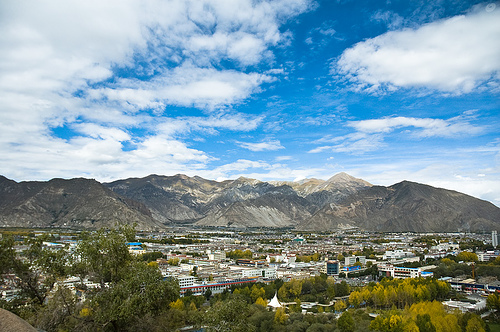
Lhasa, one of the highest cities in the world
Lhasa
Surrounded by jagged mountains and steeped in mysticism, Buddhism continues to define Lhasa’s culture. Busy markets, sweet incense and flowing yellow robes all greet you as you take your first step into the city.

After spending hours gazing out of your airplane window at snow peaked mountains, the clouds finally open up to reveal a vast plain surrounded by mountains. It’s as if you have arrived in another world of clouds, mountains and color. Lhasa is the heart of this Buddhist land hidden away amongst the mightiest mountain range in this world, the Himalayas.

In Lhasa you’ll find religion blended into every aspect life—the city is the spiritual anchor of Tibet. Lhasa literally means“holy land”and it’s a well-deserved name. With many holy sites, Lhasa is an important place of pilgrimage for people from all over Tibet who stream into the city from far-flung villages. They’re easily identifiable with their prayer flags and prayer wheels. The signs of devotion abound throughout the land.

It’s easy to forget that you’re already at an altitude of 3,650m as you look at the towering mountains that surround Lhasa, but that’s why Tibet is also known as“rooftop of the world.” The 93m trip from the airport to the city follows the winding path of the scenic Lhasa River, families work in fields of barley and yellow canolo flowers as young monks walk along the roadside. Vivid colors are set against the mountains, surrounded by ever-changing clouds and the deep blue sky.

Lhasa itself is a noisy vibrant city, a mixture of old and modern. The city has an eclectic mix of people, Tibetans with their colorful clothes, Sichuan migrants with their spicy cuisine, as well as explorers, mountaineers and tourists from all over the world. There’s a saying describing Tibetans, “that if a Tibetan can talk, he can sing; if he can walk, he can dance.” This aptly describes their lively and vibrant culture.

                                           Potala Palace

Potala Palace, is comprised of the White Palace
Potala Palace
Over 1,300 years old, Lhasa dates back to the 7th century AD when the colorful Tibetan figure, Songtsen Gampo, built his palace in Lhasa. In 1642, the 5th Dalai Lama also made Lhasa his capital and rebuilt the architectural wonder, the Potala Palace, on top of the ruins of Songtsen’s old abode. Today the Potala Palace continues to dominate the Lhasa skyline and is the most visible of all of the city’s sights. It offers one of the best views of Lhasa and the surrounding area especially in the early morning. 

The Potala Palace is comprised of the White Palace, which was the living quarter of the Dalai Lama and the central religious Red Palace. It’s in the Red Palace that you can move through narrow corridors, dimly lit by many small butter lamps, to see the jewel-encrusted tomb stupas of the 5th and the 7th to 13th Dalai Lamas. The many chapels and former apartments give an insight to what life must have been like centuries ago in this theocratic sanctuary.

                                           Barkhor

Barkhor, is one of the best places to view modern day Lhasa
One of the best places to view modern day Lhasa and its diversity of culture is in the bustling Barkhor, a section of the old city. Here, the Barkhor Market has all manner of goods from turquoise jewelry to meditation beads, colorful traditional Tibetan clothes and yak wool sweaters. Here you can watch groups of monks draped in their maroon and saffron robes mingling with Tibetans from remote areas wearing long boots, sporting daggers and large turquoise necklaces.

                     Jokhang Temple

Long streams of pious Tibetan pilgrims walk clockwise in Barkhor chanting prayers with their meditation beads, spinning their prayer wheels or performing full prostrations as they circle the Jokhang Temple, one of Tibet’s holiest temples. These devout pilgrims wear yak leather gloves and aprons to protect their hands as they slide over the rocky ground, their reverent prostrations atoning for bad deeds performed in the past. Prostrating pilgrims journey from all over Tibet to worship here.
Jokhang Temple, is one of Tibet’s holiest temples
Jokhang Temple

The Jokhang Temple, situated in Barkhor Square, is the noisy and colorful heart of Lhasa. It was built in the 7th century when Kong Songtsen Gampo wanted to build a temple to house two famous statues brought by his brides from Tang dynasty and Nepal. Being unable to decide where to build the structure, he left it up to fate and threw his ring in the air and promised to build a temple wherever it landed. 

The ring landed in a lake, striking a rock where a white stupa miraculously emerged, the lake was filled with rocks and here the Jokhang Temple was constructed. The main entrance to the Jokhang is marked by a large golden, eight-spokes of the wheel represent the Buddhist eightfold path to enlightenment and the deer serve as a reminder that Buddha gave his first sermon in a deer park.

Dim corridors lined with statues of fierce and benign guardians lead to the innermost shrine. This is the home of the oldest and most precious object in Tibet-the gold statue of Sakyammuni Buddha brought by Princess Wencheng of the Tang dynasty to Tibet 1,300 years ago as part of her dowry. Inside the inner chamber, mellow butter lamps create shadows that dance across his features. Also in the innermost shrine is a 6m tall statue of Padmasambhava, the Buddha of compassion and the half-seated figure of Maitreya, Buddha of the future. Monks often lead prayers here and it’s a great spot to watch modern Lhasa life in Barkhor Square or just sit in the afternoon sun.

--Whenever you are in Lhasa, you’re always surrounded by colorful people, striking natural scenery, humbling mountains, flowing rivers and fields of green, gold and yellow. Although some of the main temples can be busy, just turn the corner or wander off for a few minutes and you’ll quickly find yourself in a picturesque rural Tibetan scene out of a postcard.

Memory of Shanghai VII: Famous Ladies of Old Shanghai

Mention of the famous ladies of China, I think you will think of Soong ching ling immediately. Could you remember others? Hey, the famous ladies of old Shanghai we will talk about in the chapter are famous in China, even in the world.

                                                         Chapter Seven


                        Famous Ladies of Old Shanghai
                   --The Recall of the Talented Beauties

In old Shanghai, the Shanghai ladies showed their special charm to the world wide: they lived in the “melting pot” old Shanghai where they experienced the living style both in Chinese and western and received advanced education to get wide horizon of the life and world. Besides, they are independent and hard-working women who struggle for the life with talents while dressed in cheongsam showing Chinese elegance. 

Among old Shanghai’s ladies, few of them are outstanding and have great impressions not on old Chinese people, but also on the world. Some of them used their pens to write down many impressive works which influence people from generation to generation. Some of them talented in singing and acting whose songs are so melodious that they still be heard on the streets nowadays and their roles are well-figured as deep in people’s memory. 

In people’s mind, Eileen Chang, Ruan Lingyu and Zhou Xuan may be the top lady celebrities in old Shanghai. Have ever read the sentimental novels written by Eileen Chang? Have you ever watch the movies of old Shanghai styles acting by Ruan Lingyu? Have you ever listen to the beautiful songs of Zhou Xuan which have strong figures of old Shanghai?—Never mind, the following are the general descriptions for you.

1. Famous Sentimental Novel Writer—Eileen Chang


Eileen Chang, was a famous Chinese writer
Eileen Chang
Eileen Chang (September 30, 1920–September 8, 1995) was a Chinese writer who was born into an illustrious political family in Shanghai. With her prestige family background, she not only inherited the talents of her parents who were well-educated, but also relieved better education than others. However, Chang's unhappy childhood in the broken family probably gave her later works their pessimistic overtone. 

During 1940s were the golden days of Eileen Chang as most of her major works were published in this period, which represented the high point of her writing career. -- Her works frequently deal with the tensions between men and women in love, and are considered by some scholars to be among the best Chinese literature of the period. 

Actually, she offers essays on art, literature, war, and urban life, as well as autobiographical reflections. She takes in the sights and sounds of wartime Shanghai and Hong Kong, with the tremors of national upheaval and the drone of warplanes in the background, and inventively fuses explorations of urban life, literary trends, domestic habits, and historic events. 

Most importantly, her works vividly capture the sights and sounds of Shanghai, a city defined by its mix of tradition and modernity. She explores the city's food, fashions, shops, cultural life, and social mores; she reveals and upends prevalent attitudes toward women and in the process presents a portrait of a liberated, cosmopolitan woman, enjoying the opportunities, freedoms, and pleasures offered by urban life. 

All in all, Eileen Chang is no doubt the most talented woman writer in the 20th century China. That’s why after more than half a century as she first won fame in Shanghai, Chang still enjoys an enormous popularity among readers, both in China and overseas. 

2. Tragic Goddess-Ruan Lingyu


Ruan Lingyu, one of the most prominent Chinese film stars of the 1930s
Ruan Lingyu
Ruan Lingyu (April 26, 1910-March 8, 1935), a silent-film actress still remembered by many, left behind 29 films and the final message, "gossip can kill," when she committed suicide in Shanghai on March 8, 1935.

Her father, a penniless machinist, died when she was just five years old. For a while she went to live with her mother who was working as a housemaid for a rich family. She then went to a girl's school, but as soon as she had finished primary school, she began to look for a job to lighten her mother's load. She saw an advertisement for film actors and then she went for an interview and was given a job.

Her first screen appearance in 1927 was in the film Husband and Wife in Name. In 1935, during the shooting of her last film, a divorce suit and slanderous stories in unscrupulous local newspapers caused her a great deal of mental anguish. She finally decided to take her own life to prove her innocence. After years, in 1982, when a Chinese Film Retrospective was held in Italy, audiences were amazed at Ruan's talent, especially in the film Goddess. They called Ruan "China's Greta Garbo."

In spite of her lack of formal education, Ruan Lingyu was diligent and scrupulous in every detail of her acting. --Ruan's acting was so natural, accurate and graceful that, even after 70 years, her films still seem fresh. She was adept at conveying meaning through her whole body, thus overcoming the limitations of early silent films, unlike some performers today who talk and talk and express nothing through gesture and "body language."

In a word, Ruan Lingyu was a versatile character actress. In her nine-year film career, she played many different roles, such as writer, factory worker, wealthy socialite, prostitute, flower girl, nun and beggar. Her unaffected, sensitive character portrayals contrast with the false, exaggerated performance that predominates in many films today.

3. Golden Voice of China—Zhou Xuan
Zhou Xuan, was one of China's seven great singing stars
Zhou Xuan

Zhou Xuan (August 1, 1918-September22, 1957) was a popular Chinese singer and film actress. Zhou was born in Shanghai, but was separated from her natural parents at a young age and raised adoptive parents. She spent her entire life searching for her biological parents but her parentage was never established until her death. At the age of 13, she tool Zhou Xuan as her stage name as -- “xuan” means beautiful jade in Chinese. 

Zhou started acting in 1935, but achieved stardom in 1937 in Street Angel, when director cast her as one of the leads as a singing girl. By the 1940s, she had become one of the seven great singing stars. She is probably the most well-known of the seven as she had a concurrent movie career until 1953. In 1957, she died in Shanghai in a mental asylum at the age of 39 and the possible cause of her death may be encephalitis following a nervous breakdown. 

“Golden Voice” was Zhou’s nickname to commend her singing talents after a singing competition in Shanghai, where she came in second. Zhou rapidly became the most famous and marketable popular singer in the gramophone era up to her death, singing many famous tunes from her own movies. Her frail but eminently musical voice captured the hearts of millions of Chinese of her time. 

Thursday, December 6, 2012

Impression Yunnan II: Tiger Leaping Gorge

In the last article, we have talked about Lijiang, one of the famous attractions in China. Maybe you have not heard another attraction in Yunnan, we will talk about in the chapter, Tiger Leaping Gorge, which is the world famous grand canyon, and grotesque known to the world.

                                                        Chapter Two


        Tiger Leaping Gorge: Leaping tiger of water

Tiger Leaping Gorge locates about 100 kilometers (62 miles) northwest of Lijiang Old Town and lies between Jade Dragon Snow Mountain and Haba Snow Mountain).--It is the longest, deepest, and narrowest gorge in the world.

                                          Sights of Tiger Leaping Gorge

From the top of the gorge you look down the steeply angled (70-90 degrees) mountain sides to the rushing Golden Sands (Jingsha) River with its 18 frothing rapids more than 200 meters (about 700 feet) below.

Naturally divided into three sections, the first section, which is the narrowest and uppermost section, is the mouth of the fast flowing Jingsha River. In the midst of the river's mouth is a large rock that is positioned at the gorge's narrowest section-only 30 meters (33 yards) wide.
Tiger Leaping Gorge, is part of the Three Parallel Rivers of Yunnan Protected Areas World Heritage Site
Tiger Leaping Gorge

An ancient legend says that a tiger used this rock as its stepping stone so it could leap across from one side of the gorge to the other, which is how the gorge got its name.

As the river enters the middle section, it drops another 100 meters (330 feet) and its flowing rate increases to an amazing speed. Here the thunderous rushing waters slam into sharp, large rocks and crash down into the river forming swirling whirlpools. Can it get more exciting? Yes, it can as the third and lowest section is acclaimed for being the wildest attraction of all!

The cliffs over-looking this section are even steeper and much more dangerous. Here, the river twists and turns and the river vigorously surges forward creating high waves and a frothy spew as it collides with the mountainsides. This is a view that inspires a sense of adventure and satisfies the deepest yearnings for magnificent scenery.

The gorge stretches about 15 kilometers (nine miles) and also affords people the possibility of rafting and drifting peacefully in its large quiet sections, for the gentler folks among us and an exciting rafting adventure for the more experienced. Do not want to raft?

Useful Tips: This is a great sightseeing stop with enormous photo opportunities. Bring your camera, wear skid-proof shoes, and be prepared to be astonished.

                                        Navigate Tiger Leaping Gorge

The inhabitants of the gorge are primarily the indigenous Naxi people, who live in a handful of small hamlets. Their primary subsistence comes from grain production and foreign hikers. The gorge is not considered navigable. In the early 1980s, four rafters attempted to go down the gorge and were never seen again. In 1986, the first known successful attempt to sail through the gorge was made by the first expedition to float down the entire length of the Yangtze, starting at the river's high source at the Gelandandong glacier lake.

The Hiking Path, is used by the Naxi as part of everyday life
The Hiking Path
The area of Tiger Leaping Gorge was officially opened to foreign tourists in 1993, but had attracted adventurous backpackers already in the 1980s. Officials plan to improve the existing trails and roads, bringing tour buses and more development. These plans arouse highly varied reactions among the local population, from strong opposition to strong support.

Moreover, the hiking path ("the high road") is well-maintained and marked, although sometimes narrow, and is used by the Naxi as part of everyday life. This trail is longer than the lower road, approximately 22 kilometers, but more varied. It features a variety of micro-ecosystems, waterfalls, and a fair number of guesthouses for trekkers. These guesthouses are not well heated, which combined with the unpredictable nature of high mountain weather makes this trek unadvisable during the rainy season, although in recent years the raining periods got shorter and it got possible to hike there again.

Horses, are the good assistant of the Naxi people
Horses
The lower road, stretching about 195 km from Qiaotou through the Gorge, is a stretch of pavement crossed by several waterfalls, and frequently beset by rockslides. Some portions of the road have been known to disappear into the river below. The road follows the Yangtze, so there are more views of the river, and a stronger sense of being in a gorge than on the upper trail. Where the high road descends to meet the lower road, one can climb down to the river near the Tiger Leaping Stone, the point at which the tiger is said to have leaped. 

However, some locals in Lijiang will insist that this hike is dangerous, especially in rainy season. You must not go when it is pouring, or if there has been a huge amount of recent rain due to the threat of landslides. But if it hasn't been that wet lately, and you find a couple of dry days and are reasonably experienced at hiking, the worst that will happen is that you will get muddy and have to ford a couple of swollen cascades. “Safety First” is what you should always keep in mind.

--Splendid Tiger Leaping Gorge is a great place for you to experience the power of the nature. Don’t hesitate anymore, believe me, you’ll be shock and hardly find out an exact word to describe its natural brilliant!

Wednesday, December 5, 2012

Impression Yunnan I: Beauty of Lijiang


Zhang Yimou, who directed the Beijing Olympic in 2008, was the director of Impression Lijiang that a lot of tourists are familiar with Lijiang, Yunnan. The picturesque
scenic spots, mysterious folk custom and ancient culture are attract all the people from the whold world.We will talk about the main character of Impress Lijiang-Lijiang in the article.

                                                      Chapter One

                            Beauty of Lijiang

Lijiang, a popular destination in Yunnan, is considered a fairyland blessed with fresh air, clear streams, breathtaking snow mountains and an undisturbed landscape inhabited by a friendly group of people. 

Lijiang Old Town, is famous for its orderly system of waterways and bridges
Lijiang Old Town
It is great to enjoy a quiet and pleasant holiday in Lijiang Old Town which is graced by well-preserved ancient buildings and the Naxi culture.
While the geographical position of Lijiang City is remote, it has the advantage of ensuring a pleasant year round climate and a wide variety of tourist resources in the 20,600 square kilometers area. 

The earliest recorded history of Lijiang can be traced back to the Warring States Period (476 BC-221 BC) but with the advent of the Tang Dynasty (618-907), the local economy reached a peak with the development of the Ancient Tea-Horse Road which made a great contribution to both commercial and cultural communication between Tibet, Sichuan and Yunnan provinces.
At present, Lijiang City is an attractive tourist destination in Yunnan Province that exercises jurisdiction over four counties and an Old Town District. Lijiang is the main region inhabited by Naxi Group, one of China's 55 minority ethnic groups. In its long history, the local residents have established their splendid Dongba Culture which has absorbed aspects of the culture of Tibet and the Central Plains along the middle and lower reaches of the Yellow River. The various souvenirs marked with these Dongba hieroglyphs are very popular with visitors from home and abroad.

● Features of Lijiang

1. Old Naxi architecture and special water system are the outstanding features of Lijiang.

It is designated as a UNESCO World Heritage List special preservation area.

Naxi Cuisine, is very delicious
Naxi Cuisine
3. Naxi Cuisine: The local Naxi cuisine features a lot of high-protein dairy and beef products like yogurt, yoghurt-honey-fruit blends, yak milk tea, yak cheese, warm yak milk, yak steak and yak butter. This is unusual in China. Yaks are related to cows and buffalos. Of course, there are many kinds of restaurants in the city.

4. About half an hour north is Jade Dragon Snow Mountain with several scenic park areas, some hiking trails and a 4,680 meter (15,354) foot peak. People can climb to near the top of the peak on a stairway and pass by a glacier.

Jade Dragon Snow Mountain, is a AAAAA-classified scenic area
Jade Dragon Snow Mountain
5. The Leaping Tiger Gorge area has great hiking and scenic sights. If the road is open, there are many tour buses available.

6. The city gives access to other scenic and hiking areas include the First Bend of the Yangtze River and Lugu Lake.

7. Naxi beverages include various kinds of tea such as yak milk tea and traditional beer.

8. It was a trading town on the historic Chama Road (Southern Silk Road).

● Touring Activities

1. Visit the ancient districts, shop and dine.

2. Go on high country walks and see the scenery. Hike above the Yangtze River.

3. Take a bus tour in the Leaping Tiger Gorge area.

4. Enjoy some protein-rich Naxi cuisine.

5. Go to other nearby ancient areas such as Dali that is 3 hours south or to natural sites in the Three Parallel River UNESCO Heritage Site areas. The Leaping Tiger Gorge area is one of the UNESCO listed natural preserve sites.

● Travel Information

Black Dragon Pool, is a famous pond in the scenic Jade Spring Park
Black Dragon Pool
1. Best Time to Visit: The urban area of Lijiang has a fairly temperate climate. In the winter, the nightly low temperatures are just above freezing. Of course, the conditions on the mountains can be extreme. To hike in the mountains, the best times are the month of May or in the fall. These months are outside of the annual rainy season that extends from June to September, and the temperatures at the lower elevations are cool or warm.

2. Dayan Ancient City District is a pedestrian-only area.

3. Parks: Black Dragon Pool and Yuquan Park are just to the west of the Dayan Ancient City District. You can walk there.

4. Since there is less modern construction around the Baisha Quarter and Shuhe town, those might be places to better appreciate the traditional culture.

Naxi people, the main nation in Lijiang
Naxi people
5. Clothing and Altitude: The altitude is about 2,400 meters or about 7,800 feet. Some people may get some altitude sickness. So take it easy the first day or two. In the winter, the low nightly temperatures are a little above freezing. So bring plenty of clothes. Bring rain gear for the rainy season between June and September.

6. Warning Tip: The cobblestones are slippery when they are wet, so please be careful when walking on them.

--The beauty of Lijiang is waiting for your own discovery. Go and explore and then you will find all the fantastic there.

Tuesday, December 4, 2012

Relaxation in Chengdu III: Giant Panda in Sichuan

Do you think what the symbol of China is? Dragon? Hey, I think the one we will talk about in the article, which is another leisure attraction in Chengdu, and also is another symbol of China, should be familiar to you.

                                                         Chapter Three


China's National Treasure--Giant Panda in Sichuan


The giant panda, regarded as one of China's National Treasures, is on the verge of extinction. Today there are fewer than 1,000 giant pandas living in the world. The giant panda is the symbol of eco-environmental conservation. Visitors to China can see this reclusive animal in Sichuan Province's Chengdu Research Base of Giant Panda Breeding. We hope, with their cute faces, unusual beauty and grace, giant pandas can bring visitors to China pleasure and enjoyment.

Living Fossils

Lovely Panda, are you playing hide-and-seek with me?
Lovely Panda
Paleontologists have discovered fossil remains that indicate that over 8 million years ago ancestors of the giant panda were living in China. That is the reason why the giant panda is has been called one of China's "living fossil" by historians.

The giant panda's lifespan in the wild is unknown, but in captivity they average more than 20 years. Due to the constant expansion of human activity, the habitat of giant panda has been gradually shrinking and they are now only found in the southern part of Gansu province and northwest part of the Sichuan basin.

Bears or Raccoons

The giant panda has lived for millennia in the dense bamboo woodlands on the eastern edge of the Qingzang Highland in western China, living a "hermit-like" existence. Due to its unique physical form, and peculiar characteristics, scientists have never been able to classify the giant panda as belonging to the bear or raccoon family, or whether it needs to have its own classification.

Plump and Lovely

Panda Cub, was born a few days
Panda Cub
The giant panda looks quite plump. Its body length is about 160 to 180 centimeters, and weighs 80 to 125 kilograms. The giant panda's colorization is simple but elegant. Normally, the giant panda is very gentle and reclusive, like a shy lady. When the panda meets strangers, it often covers its face with its palm, or lowers its head to hide its face. After giving birth however, a female giant panda can be very aggressive using her teeth and claws to protect her infant.

Bamboo

Giant pandas are considered carnivores, but 99% of their food consists of bamboo. They prefer bamboo shoots. Since bamboo is low in nutrition, giant pandas attempt to reduce the sphere of their activities, to use less energy. These solitary animals spend most of their time eating. Giant pandas are excellent tree climbers, and are very fond of play.

Thick Hair

Frolic Panda, we are good friends.
Frolic Panda
Giant pandas have developed a set of unique characteristics that have enabled them survive extreme cold and dampness. The hair on the body of a giant panda is exceptionally thick, and the giant panda's skin secretes an oily substance that coats their hair making it waterproof, which allows them to comfortably sleep in the snow, and consequently they do not hibernate during the winter. Due to these unique adaptations, the giant panda has no problem living in bamboo forests with an average humidity level of over 80 percent.

Recluse in the Bamboo Forest

Giant pandas live alone and scattered, rather than living in herds. Because of this, the giant panda is often called "the recluse in the bamboo forest". They do not move too far from their home base, and live their entire lives in a small area. The giant panda can eat at any time, and sleep in any place. They have a truly easygoing lifestyle.

Over 80% of the world's giant pandas live in Sichuan Province. The Chinese government now has established two large breeding bases to breed and save this precious species. One is the Wolong Research Base of Giant Panda Breeding, the other one is the Chengdu Research Base of Giant Panda Breeding.

Red Panda, is not the preschool period of giant panda, but another breed of Panda
Red Panda
Chengdu Research Base of Giant Panda Breeding covers an area of over 359,000 square meters and it is now under expanding for an area to over 1,999,000 square meters. As the first ex-situ conservation project for giant pandas, this base has not only dedicated itself to giant panda conservation, but has also endeavored to combine natural scenery and man-made landscapes to create wonderful and humane living areas for giant pandas, red pandas, and other Chinese endangered animals.

This panda research breeding base has state of the art facilities. It appears to be a beautiful landscaped park. Luxuriant bamboo grow everywhere around the base. Here 15 pandas live a protected life, where visitors can view them eating, sleeping or playing. Visitors can also learn more about this precious species in the giant panda museum. The panda hospital can also be visited, where there is a 7,000 square meter educational space for the foreign and domestic visitors. In these learning areas, visitors will come to know more about the work being done to preserve this lovely animal.

Monday, December 3, 2012

Relaxation in Chengdu II: Mount Emei

As we know, Buddhism is one of the popular religions in China. Mt. Emei, is one of the four most sacred Buddhist Mountains. In the last article, we have talked about the general situation of Chengdu city. For better know the leisure place, today we will talk about a famous tourist attraction-Mt. Emei.

                                                        Chapter Two


                                Mount Emei

Mt. Emei is located in Leshan City, Sichuan Province. It is the highest of China's four holy Buddhist mountains, rising 3,099m above sea level about 170km from Chengdu, Buddhists believe the mountain is home to Samantabbadra-patron of the Lotus Sutra and Bodhisattva of Pervading Goodness.

Mt. Emei, is one of the four most sacred Buddhist Mountains
Mt. Emei
Geological processes going back over hundreds of millions of years have created the unique topography of Mt. Emei, and cultivated its rich plant and wildlife. Over 3,000 species of wild plant grow on the mountain, including the Chinese dove tree, which has already become extinct in other parts of the world. 

The flower of the Chinese dove tree takes the shape of a pigeon, and when in full bloom, gives the impression of a flock of pigeons flying in and around the tree. The lesser panda and the gnu are just two of the rare animal species that live on the mountain.

It is towering, beautiful, old and mysterious. Mt. Emei is like a huge green screen standing in the southwest of the Chengdu Plain. Looking its winding and beautiful figure, you will find that it resembles very much an eyebrow of a girl. It is the highest one among all the famous sight-seeing mountains in China.

Mt. Emei is a sacred Buddhist site, and has a Buddhist history of over 1,500 years. It is said that during the 15th century, there were as many as 1,000 monks living on Mt. Emei. According to the records inscribed on a number of stone tablets, an eminent Indian monk came to spread the Buddhist doctrine as early as the 4th century. Later, Emperor Mingdi of the Eastern Han Dynasty ordered that Puguang Hall on the mountain be expanded into a temple, setting a precedent for the imperial court to construct temples on Mt. Emei. 

From that time onwards, emperors of succeeding dynasties all endowed celebrated temples and eminent monks on the mountain with their gifts. Today, it still houses numerous relics of poems, couplets (written on scrolls and hung on the pillars of a hall), and inscriptions bestowed by emperors and scholars of ancient times.
In Mt. Emei there are four scenic regions: Baoguo Temple, Wannian Temple, Qingyin Pavilion and Golden Summit. Its main peak, the Golden Summit, is 3079.3 meters (10,103 feet) above the sea level, seemingly reaching the sky. Standing on the top of it, you can enjoy the snowy mountains in the west and the vast plain in the east. 

In addition in Golden Summit there are four spectacles: clouds sea, sunrise, Buddha rays and saint lamps. In 1996 Mt. Emei was enlisted in the world natural and cultural heritage by the UNESCO.

Must-seeing Sights 

1. Samantbhadra

Samantbhadra, is a bodhisattva in Mahayana Buddhism associated with Buddhist practice and meditation
Samantbhadra
Samantbhadra, God of Universal Benevolence and disciple of Sakyamuni, was said to have lectured here. Most of the temples on Mount Emei have a statue of Samantbhadra at the shrine. 

There were once more than a hundred temples and monasteries on the mountain, but only about twenty remain today, including the following better-known ones: Devotion to the Country Temple (Baoguosi), Ten-Thousand-Year Temple (Wanniansi), and Immortal Peak Temple (Xianfengsi), and the temple at Elephant Bath Pond (Xixiangchi)

2. Golden peak

Golden peak, a famous attraction in Mt. Emei
Golden peak
The summit of Mount Emei commands a grand view of rolling mountainpeaks, sometimes visible, sometimes emerging from the clouds like small islands in an enormous ocean. This is the famous "sea of clouds" view of mount Emei. Walking downhill from the summit for about three hours, you will come across Elephant Bath Pond.

According to the old legend, Samantbhadra, Sakyamuni's disciple, once bathed his elephant in this pool before continuing his ascent of Mount Emei or, as others say, before flying to heaven on the elephant's back. Monkeys live in the vicinity; they often approach visitors to beg for food.

3. Immortal Peak Temple

Immortal Peak Temple, is another famous attraction in Mt. Emei
Immortal Peak Temple
Immortal Peak Temple was built 1,700 meters above sea level on the slope of Mount Emei. Next to the temple is a big cave where, as the legend goes, the Yellow Emperor who was visiting the place met a white-haired old man who had a young face. The emperor asked him if he had any company, and the old man replied, yes, there are eight others in the cave. Since then, the cave has been called the Nine Elders Cave (Jiulaodong).
Five kilometers downhill from Immortal Peak Temple, there stands the Clear Sound Pavilion (Qingyinge), another well-known scenic site on Mount Emei. Below Clear Sound Pavilion, there are Double Flying Pavilion (Shuangfeige) and Double Flying Bridge (Shuangfeiqiao). 

The nearby White Dragon Cave (Bailongdong) is said to have been the place where Lady Bai Suzhen, a legendary nymph who was originally a white snake but later became a beautiful girl, cultivated her magic skills.