Friday, June 14, 2013

40 Best Scenic Spots Recommended by CNN II: The Mountain Resort and its Outlying Temples, Chengde

In Qing Dynasty, Chinese emperors always go to a palace to avoid the hot summer, and it's Chengde Mountain Resort. What is it? We will talk about it in the article.

Chapter Two


The Mountain Resort and its Outlying Temples, Chengde

Chengde Mountain Resort is located in the north of Chengde city, Hebei Province, 230km away from Beijing city. It is one of China’s four famous gardens. The others are Suzhou Humble Administrator’s Garden, Suzhou Liu Garden and Beijing Summer Palace. Listed in the World Culture Heritages, Chengde Mountain Resort was used to be a palace for Chinese emperors avoiding the hot summer in Qing Dynasty. If you plan to have a China tour, the information about Chengde Mountain Resort is beneficial to you. 
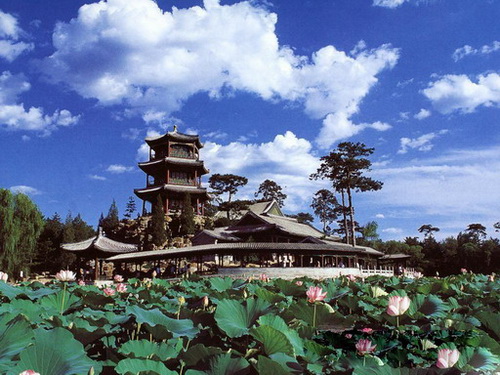
Lotus Pond, the beautiful scenery of Lotus Pond under the beautiful sky.
Lotus Pond


The history and construction of Chengde Mountain Resort

Chengde Mountain Resort is found from 1703, after three generations of emperors in Qing Dynasty, Kangxi, Yongzheng and Qianlong. It took 89 years to build.

It is composed of emperor palace, emperor garden and magnificent temples. The overall arrangement can be generally divided into two parts, palace area and garden scenic spots. And the garden scenic spots is divided into lake region, plain area and mountain area. 72 classic scenic spots made by emperor Qianlong are inclusive of garden scenic spots, including numerous palaces, halls, buildings, pavilions, terraces, waterside pavilions and other Chinese style architectures.  Nowadays, this mountain villa is still remained intricate and elegant royal garden and a 70 meter-high pagoda. Lash grass growing, green mountains towering, the canyons scenery tranquility, all these make the mountain villa still a summer resort today. The most characteristic of Mountain Resort is gardens decorating mountains and vice versa. You won’t miss Chengde when you take a Classic China tour.

The Climate of Chengde Mountain Resort

Chengde Mountain Resort is located in the belt of transition between Inner Mongolia Plateau and North China Plain. The monsoon mountain climate of it belongs to temperate continental climate, with four distinct seasons. Winter there is warmer than other same latitude areas because the mountains around the villa stop the attack of cold current from Mongolia Plateau. Summer is cool basically without sweltering hot weather and rainfall is concentrated. It is a wonderful tourism summer resort. Welcome to take a Chengde tour in hot summer. 
Pavilion on the water that you can avoid the insolation in Summer.
Pavilions on the Water


The Best Traveling Time

Late summer and early autumn is the best season to visit Chengde Mountain Resort when you take a China tour. At that time, whole China is in hot summer, while the temperate inside villa is lower 3 or 5 degrees than outside villa. Chengde Mountain villa is a well-deserved summer resort. Moreover, you can see the lotus blossom filled with the ponds in villa. The Resort lotus run a high reputation in the world because they are best cultivars of lotus for emperors from other places and sightworthy. Besides, the flower season lasts long time from early July to late September. 
Please note that November to next May is the season of forest reservation, so people are not allowed to climb the mountains in villa with their Chengde tours.

The Transportation of Chengde Mountain Resort

Chengde Mountain Resort is situated in the urban Chengde city with convenient transportation. There is no airport in Chengde at present but many trains pass through Chengde city, such as Beijing-Chengde rail, Beijing-Tongliao rail, Chengde-Shijiazhuang rail and Chengde-Shenyang rail. When you take a Chengde leisure tour, you can reach the Resort by No.5, No.7 and No.11 bus or by a taxi there after you get off your train. 


Local Specialty

By you China Chengde tours, you may buy various kinds of native products in Chengde mountain resort tourism designate stores, such as mushroom, almond, filbert and hawthorn. There are also many tourist souvenirs with local characteristics, such as jade ware, Tengshi cloth paste painting, root carving and walnut skin handicrafts. 
Filbert, one of the most famous specialty in Chengde, you won't miss it if you take a China travel tour.
Filbert

Traveling Line

Mountain Resort area is vast. If you have only one day to take a Chengde tour, the following line can cover the most essences of the villa.

Lizheng Gate----Neiwu Gate----Danbojingcheng Palace----Sizhi Reading Room----Yanbo Zhishuang Palace---Yunshan Shengdi Building----Cailing Cross----Ruyi shoal----Yanyu Building---Canglang islet----long lake---Wenjin Castle----Rehe Spring----Jinshan Pavilion----Shuixin waterside Pavilion----- Ruins of Eastern Palace----Dehui Gate.

Other choice of lines:

East line: Get in from Dehui gate, cross Eastern Palace. Along the east line, the scenic spots can be seen are Shuixin Water Pavilion, Wen Garden, Qingshu Mountain House, the Moonlight and Sound of Water, Jiede Hall, Huiwan Zongchun Temple, New Place, Golden Mountain, Xiangyuanyiqing, Rehe Spring.

Mid-court line: Go down Wanhe Songfeng Step Level Road to Ruyi Lake, cross the arch bridge, through Zhijingyun embankment, Cailing Cross, Ruyi shoal, to the end Qinglian Islet (Yanyu Building).

West line: Out of the Palace Gate Xiuyun, down Yulin Slope, along northward the west line of Ruyi Lake to Shuiliu Yunzai. Eastward to Pingxiang bank or still northward to Wenjin Castle. West line is the traveling line of Huzhou area, also an arterial traffic connecting the four functional partition of whole garden. 

Notes:

1. Open hour: 8:00am-17:30pm.
2. Gate ticket: high season(1 April to 31 October) 120RMB/ person.
            Low season(1 November to 31 March) 90RMB/ person 
3. The holiday villages need to book in advance in summer because of huge house demand at that time.
4. Following a tour guide is the best choice to visit Mountain Resort. It is not only increasing your Chinese history knowledge but also insuring that you would not miss the essential points which are out-of-the-way. 
5. The scenery of Huzhou area is the most beautiful place in Mountain Resort. Rowing a boat on the lake is a good idea to experience the landscapes of lakes and mountains. You can rent a boat on the west bank of Ruyi Lake and many kinds of boats can be chosen by yourself.
6. Some palaces are restored to be museums to exhibit the history and royal artworks of Qing Dynasty, such as Zheng Palace, Songhe Zhai, Eastern Palace and Wanhe Songfeng.
7. Taking a round hill touring car is a easy way to visit the most scenic spots in Mountain Resort. Please remember safety first!
8. Taking good care of yourself and your carry-on luggage when traveling. 

Saturday, June 8, 2013

40 Best Scenic Spots Recommended by CNN I: Wuyuan ---- a Place of Stillness

Recently, CNN announced the 40 best Scenic Spots in China on its official website. Some of them may be you are familiar with them, but some may be strange. In the series, we will talk about them one by one.

Chapter One


                       Wuyuan ---- a Place of Stillness

The Special Beauty of Wuyuan Attractions

Wuyuan County, located in the northeast of Jiangxi Province, owns a high reputation of the most beautiful village in China. It is famous for its rape flower fields, old folklore custom and classic well-preserved historic architecture. Every year, thousands of people are pouring in Wuyuan to experience its beautiful scenery. Here I will focus on the rape flower and Shanqiu scenic spot in Wuyuan for you if you take a leisure tour in China.

1. Rape Flower in Wuyuan

Blooming Rape Flower and Village, you will enjoy it in a China travel Tour by GreatWallDiscovery China Travel Agency.
Blooming Rape Flower and Village

The best time to visit Wuyuan, China is the spring every year especially in late March to early May when you take a China Tour. At that time, pink beach blossom and white pear blossom are scattered in endless golden rape flowers and Wuyuan turns to be a yellow rape flower sea, just like a dreamed fairyland. Houses with white walls and gray tiles of Hui-style are hidden in the flower sea. The landscape makes a person who escapes from the modern cities find a home to return to. 

Unlike of the rape in many other places, Wuyuan rape is filled with another aroma because of its landscape and history: mountains surrounded, sky blue and clear, rivers and streams limpid, ancient villages with local culture and Hui-style houses dotted in the vast sea of rape flowers, Wuyuan is like a Chinese ink painting with rape blossoms and green willows. Wuyuan is an ideal place to enjoy the wonderful spring, and golden rape flower is the mass-tone attune in the spring palette. Especially after an overnight rain, sea of clouds surge into Wuyuan mountains before the sun showing up. Ancient villages on the top of mountains are indistinct in cloud waves. Light fragrance of rape flowers drift into the valley and midair, rape fields winding from the foot of mountains to the top of mountains, layers upon layers. 

Along the way, rape blossoms floating and flowing, yellow petals in the rain is especially attracting people. Standing on the highest point of village, you will be gradually melted by the fantastic rural scenery: yellow meets your eyes on every side, rural flavor brings by the wind, drizzle jumps in your face.....  

2. Shaiqiu Scenic Spot
Autumn Scenery of Wuyuan, appreciate it by taking a Best China Tours to Wuyuan.
Autumn Scenery of Wuyuan


If you go to Wuyuan in Autumn when taking a China tour package, you must go to Huangling to see Shaiqiu Scenic Spot. Autumn is a harvest season for farmers. Every family dry their harvests in the autumn sun before winter comes. So all kinds of crops are dried such as hanging in bamboo poles or lying on roofs. The whole village roofs are covered with colorful crops, dry red peppers, glistening yellow corns and pieces of pumpkins, filled with farmhouse flavor.

Transportation in Wuyuan

If you take a China tour from Guangzhou city, there are expresses to Wuyuan in there, but you may feel a little tired because of long time. If by train, you can arrive in Nanchang City then transfer to Shangrao. By air, the airports near Wuyuan are Jingdezhen airport(nearest), Nanchang airport(most flights), Quzhou airport, etc.  

Cuisine in Wuyuan

Pouch red carp is a Wuyuan specialty with delicate delicious fish. You won’t miss it in your China Wuyuan tour. Local chicken, edible wild herbs and cured meat are also worthy of eating in Wuyuan.
Pouch Red Carp is one of the delicious cuisine in Wuyuan and you won't miss if you travel in China.
Pouch Red Carp


Shopping in Wuyuan

Wuyuan specialty can be summarized as four clours: red(pouch red carp), green(green tea), black(dragon tail inkstone) and white(snow pear). You can have a try of them if you take a China tour package.

Travel Tips

Tourists travel to Wuyuan can buy a travel pass to visit all the major tourist attractions in 5 days, including Likeng Town, Wankou Town, Jiangwan Town, Xiaoqi Town, Wangkou Town, Jiangwan Town, Xiaoqi Town, Sixiyan Village, Rainbow Bridge, Dazhang MountainWolong Valley, the Column of Ancestral Hall, Scenic Area of Lingyan Cave, Wengong Mountain, Stone City, Yuanyang Lake, and Yantian Camphor Tree Garden.

Some traveling routes are reference for your China tour:

East line: Wuyuan Museum→Moon bey, a small island in lake→ Likeng, a beautiful village→ Wangkou, the ancient port of temple→Xiaoqi, a preliminary ancient culture village→Jiangwan, Great man’s hometown→ Huangling, a dreamland terraced fields→ Jiangling, a heaven on earth.

West line: county town----scenic spots of Wengong Mountain-----ancient city----Jinshan Tea Garden-----Yuanyang Lake-----Changxi, a land of idyllic beauty. 
Enjoy the beautiful scenery of Wuyuan, the most beautiful village in China recommended by CNN.
Overview of Wuyuan


North line: county town----Congxi Rafting----Sixiyan village----Rianbow Bridge----Likeng-----Lingyan Cave-----Dazhang Mountain Wolong Valley-----Stone City----Qingfeng Cave-----Yantian Camphor Tree Garden----ancient pass road.

Note:
Please pay attention to the notes when you take a China tour.

1. Remember to take one more clothes(a coat or a sweater) because the range of temperate in Wuyuan is fluctuate between 10 to 25 degree in spring and autumn; better to take your rain gear and first-aid medicine at hand when you hike Wuyuan countryside in summer just in case. 
2. Prepare your own sleep bag if you have interest to lodge in local peasant family.
3. The best time to photo the beautiful scenery of Wuyuan is late March and late November.
4. The local people are very friendly. They don’t reject to be taken in photos but please carry out if you promise to send the photos to them.
5. Keep in mind this little knack if you want to have a fun in Wuyuan: go to east to enjoy the mountains, go to north to appreciate the water, lodge out of the county town, riding early rather than later. 

Tuesday, June 4, 2013

Scenery of RMB Banknotes VI: Great Hall of the People, Beijing

The largest bill of RMB is 100 Yuan. It's red and different from other bills. Can you guess what the scenery on its back? I can tell you it's a architecture in Beijing. Haha, don't you guess it? In the article, we will talk about it.

Chapter Six


RMB 100 Note: Great Hall of the People, Beijing

Attraction: Great Hall of the People, Beijing
Opening Hours: Dec.-March. 9:00-14:00
                         Apr.-June. 8:15-15:00
                         July.-Aug. 7:30-16:00
                         Sept.-Nov. 8:30-15:00.

The visiting hours greatly depend on the meetings scheduled in the hall. If some important national or international meetings are going on in the hall, visitors are usually asked to wait until the meeting ends.
Best Time to Visit: the four seasons all appropriate
RMB 100 Note, the obverse side is the head portrait of Chairman Mao Zedong and back is the Great Hall of the People in Beijing.
RMB 100 Note


The back pattern of 100 yuan notes is the Great Hall of the People, which is located in the west side of Tiananmen Square, and faces with the National Museum. There are stone pillars on the left side of the notes. The scene is viewed from the National Museum.  

The outside of Great Hall of the People

To the west of Tian’anmen Square lies the Great Hall of the People, one of the truly grand modern structures of Beijing. Its green and yellow glazed-tile roof, magnificent portico and colonnades, and rows of pines and cypresses create a look both solemn and immense.

The Great Hall is the place where national conferences and large international events are held and where Chinese leaders meet foreign leaders. A national emblem of People's Republic of China hangs over the main gate. Twelve 25-meters-high marble pillars set on 5-meters-high marble foundation, making the hall extremely solemn and magnificent.
Constructed in ten months in 1959, this impressive structure is 336 meters long from north to south, 206 meters wide from east to west, and 46.5 meters high at the highest point.

The Inside of Great Hall of the People

It can be divided into three main sections: a 10,000-seat auditorium in the middle, a banquet hall on the north side where 5,000 people can dine at one time (as was done on the occasion of Richard Nixon's visit to China in 1972) and the offices of the Standing Committee of the National People's Congress on the south side.

The exterior of Great Hall of the People, you can visit it to take a China Beijing Tour.
Great Hall of the People

The facilities inside the hall are very sophisticated. Many are fascinated by a series of reception halls named for each of China's province, decorated in local style, simple and restful, pleasingly austere and in perfect taste.

The Great Hall of the People is now open to both domestic and foreign visitors. 

Note: 
No bags are allowed inside the building, but a bag depository is located outside the East Gate of the Great Hall. The East Gate is the only place for visitors' entrance. Guides are available in the hall, but the tour is only in Chinese.

Tuesday, May 28, 2013

Scenery of RMB Banknotes V: RMB 50 Note --- Potala Palace, Tibet

In this article, we will talk about another scenery of RMB banknotes. If you know something about China, I think you may hear the mysterious Tibet. If you take a Tibet China tour, the Potala Palace is a must see attraction you shouldn't miss.

Chapter Five


RMB 50 Note: Potala Palace, Tibet

Attraction: Potala Palace, Tibet
Openning Hours: 9:00 - 12:00, 15:00-16:30 
Best Time to Visit: May-October, avoid the rain season and severe winter

The primary image on obverse side of the new 50 Yuan note is chairman Mao Zedong, just like the other RMB, while the primary image on the reverse side of it is a picture of the Potala Palace in Lhasa , in the Tibet Autonomous Region. (See image on the left)
RMB 50 Note, the obverse side is the head portrait of Chairman Mao Zedong and back is Potala Palace, Tibet.
RMB 50 Note

History of Potala Palace

Potala Palace, one of the architectural wonders of the world, is the symbol of the sacred land Lhasa. It was built in the 7th century by King Songtsan Gambo, unifier of Tibet, for his bride, the Han nationality Princess Wen Cheng of the Tang dynasty Emperor. The Buddhists later named it Potala Palace, meaning the sacred land of Buddhism. This structure was later burned to the ground during a war and was rebuilt in the 17th century by the Fifth Dalai Lama. Repeated repairs and expansions until 1645 finally brought the palace to its present scale.
After the restoration in the 17th Century, this palace had become the residence of Dalai Lamas in wintertime as well as the power center of the Tibetan regime that integrates the religion and politics. 

Location and Construction of Potala Palace 

Located on the Red Hill in Lhasa, the palace is a 13-story palace complex, 117 meters high, standing at the top of a cliff more than 3700 meters above sea level. It occupies an area of over 360,000 square meters, measuring 360 meters from east to west and 270 meters from south to north.
The complex is of stone and wood structure. The roofs of the main buildings are in traditional Han architectural style with upturned eaves, tinkling bells at each corner and gilded yellow tiles.
The Potala Palace consists of two sections: the Red Palace in the center, used for religious functions and the White Palace on two sides, comprising halls, temples and courtyards, serves as the living quarters of Dalai Lama.
Collected a large number of sculptures, murals, scripture and other valuable cultural relics, the palace on the whole is typical in Tibetan style, with a large collection of jewelry inside, which earns it the reputation of a palace of the art. In 1994, the Potala Palace of Lhasa joined the list of World cultural Heritages in China.
Potala Palace, the view of the landmark of Tibet, China, you will appreciate it if you travel in Tibet, China.
Potala Palace


Nowadays of Potala Palace

Today, Potala Palace is a museum and temple, thousands of tourists and pilgrims surging up. It is no more like it before only Emperor and ministers, like Forbidden City in Beijing. But the daily entry quota is 2, 300 more than before 1,500 since July 1, 2007, when the Qinghai-Tibet railway was put into operation. A limit on entry is necessary for the protection of the Potala Palace, making the sacred palace more mysterious.

Anecdote 

Potala Palace is located in the center of Lhasa. It is the holy land of Tibetan Buddhist, built on the top of Lhasa River Valley Redhill, majestic and impressive. In order to produce of 50 yuan notes of the fifth series of the renminbi, the two senior artists of Banknote Printing and Mint came to Lhasa to inspect. They looked for a long time, and finally found the best angle on the top of a water treatment plant, where they took photos first, made a sketch map, and then designed the final pattern on the renminbi. 


Tips:
1. Hats should be off when you enter Potala Palace.
2. Taking pictures is not allowed inside Potala Palace.
3. Thresholds can not be treaded. You had better stride them.
4. The best way to visit Patala Palace is to enter from the back door exit from the front gate. You will be more leisure.
5. You can find the best angle to take photos of panorama of Potala Palace on Yaowang Mountain. 
6. If you like tasting local snacks and shopping, Barkhor Street is an ideal place for you to experience, which is full of local snacks and local goods in minority style. 

Monday, May 13, 2013

Scenery of RMB Banknotes IV: RMB 20 Note: Li River, Guilin

There are 3 famous rivers in China: Yangtze River, Yellow River and Li River. If you travel in Guilin, Li River is the must-see attraction. And, it's also the scenery of RMB 20 Note. In the article, we will talk it about.

Chapter Four


RMB 20 Note: Li River, Guilin

Attraction: Li River, Guilin
Openning Hours: Full Day
Best Time to Visit: April-October
Highlights of Li River

1. Upstream Attractions: Elephant Trunk Hill, Zizhou, Gamecock Mountain, Holy-water vades Mountain, Father and Son Mountain, Wilkes Crossing, Qifeng Town, Yellow Cattle Gorge, Daxu Ancient Town
RMB 20 Note, the obverse side is the head portrait of Chairman Mao Zedong and back is Li River, Guilin.
RMB 20 Note

2. Midstream Attractions: Amah Rock, Lawn, Crown Cave, Carp Hang Wall, Embroider Mountain, Fairy Mill, Half Crossing, Taoyuan Moon, Guzhui Mountain, Yangdi, Jilong Mountain, Nine Horse Mount, Green Peaks Reflected on Water

3. Downstream Attractions: Beauty Look Mirror, Shutong Mountain, Tianshui Village, Spiral Shell Mountain, Snow Lion Mountain, Cormorants, Green Lotus Peak, Yangshuo

The primary image on the reverse side of the 20 Yuan note is a view of a fisherman on his bamboo raft floating down the Li River through the spectacular Karst mountains of Guilin.

Li River, one of the symbols of Guilin, which boasts the largest and most beautiful scenic area in China and attracts thousands of visitors each year. It’s also the must-see attraction if you travel in Guilin.
Li River, a view of a fisherman on his bamboo raft floating down the Li River.
Li River


The 83-km-long waterway from Guilin to Yangshuo is like an artist’s masterpiece. The landscape is decorated with rolling hills, steep cliffs, fantastic caves, leisurely boats and is lined with bamboo. A poem says: "The river is a green silk ribbon, and the hills are jade hair-pins". Mostly the cruise starts from Zhujiang Wharf. It is about 40 minutes’ drive from Guilin city. 

Li River Cruise offers admirers a unique classical Chinese ink painting with its green hills, crystal water, verdant bamboo and clear water reflection. Along the Li River, sweet water makes the mountains come alive, while the existence of those graceful mountains makes the water more limpid. There is no doubt that Guilin has the perfect combination of mountain and water and has been the best representative of Chinese landscape, just as the former US President Clinton praised "No place in China is more evocative of the beauty of your country than Guilin". "The river winds like a green silk ribbon, while the hills are like jade hairpins" written by Han-Yu (768-824), a famous Chinese poet in Tang Dynasty.

Scenery of RMB Banknotes III: RMB 10 Note: Kui Gate in Yangtze River

Yangtze, one of the top 10 scenic spots in China,is made of Qutang Gorge, Wu Gorge and Xiling Gorge. Qutang Gorge, the back pattern of 10 yuan, which will be talked about in the article.


Chapter Three


RMB 10 Note: Kui Gate in Yangtze River

Attraction: Kui Gate in Yangtze River
Openning Hours: Full Day 
Best Time to Visit: April-September
Highlights
1. Chijia Mountain 
2. Inscriptions on Cliffs
3. Ancient Pland Path 
4. Bellows gorge 
5. Fengjie Ancient City
6. Eight Battle Formation
7. Baidi Town
RMB 10 Note, the obverse side is the head portrait of Chairman Mao Zedong and back is Kui Gate in Yangtze River.
RMB 10 Note

Kui Gate, also named Qutang Pass, is the gateway from the Sichuan basin to the Three Gorges at the Yangtze River with high mountains towering on both banks. Qutang west Baidicheng Fengjie, Wushan Daixi east, in China and the Three Gorges-known. Gap cliffs to the north and the south shores Men 1000 960, knifed Fuxiao general, A Report on the surging more than 100 meters was no wider than the narrow River Road. On the cliff  are engraved five characters (Kui Gate, the Grandest of All).  

Kui Gate, one of the parts of the Yangtze River, the longest river in China and the third longest in the world, has rich and extensive hydroelectric resources. In 1995 construction began on the massive Three Gorges Dam near Yichang and is scheduled for completion in 2009. The dam is expected to help control the flooding of the Yangtze River Valley. The Three Gorges (the Qutang Gorge, the Wuxia Gorge, and Xiling Gorge) will also be the largest electricity generating station in the world.
Qutang Gorge, the overview scenery of Qutang Gorge.
Qutang Gorge


The Yangtze Three Gorges Cruise (lasting three to five days) is incredible, providing the most exciting and unique river trips in the world. You will be excited, inspired and dwarfed by towering peaks and mile-high cliffs standing face to face on either side of the Yangtze River. Many of our guests have remarked how impressed they were with the Yangtze Cruise. " This was a fabulous trip that I really enjoyed .It was relaxing, interesting, and slow paced. But a Yangtze River cruise is the only way to see this part of China that will be undergoing dramatic changes during the upcoming years." 

You can abandon yourself to the adventure of exploring the Three Gorges, but don't forget to look for the location of the painting on the reverse of the 10 Yuan note!

Wednesday, May 8, 2013

Scenery of RMB Banknotes II: Mt. Taishan, Shandong

There are five famous mountains in China: Mt. Taishan in Shandong,  Mount Hengshan in Hunan, Mt. Huashan in Shaanxi, Mt. Hengshan in Shanxi and Mount Song in Henan. And the Mount Tai is the first of the five mountains, which is also the back pattern of 5 yuan. In the last article, we talked about the back pattern on 1 Yuan, in the chapter, we will continue our RMB banknotes journey about 5 Yuan.

Chapter Two


RMB 5 Note: Mt. Taishan, Shandong

Attraction: Mt. Taishan, Shandong
Openning Hours: 7:30 - 17:30 
Best Time to Visit: May-November
Highlights
1. Eighteen Bends 
2. Southern Gate 
3. Rising Sun 
4. Dai Temple 
5. Sunrise of Mountain Tai 
6. Top 6 Scenic Spot (You Area, Kuang Area, Ao Area, Miao Area, Xiu Area, Li Area) 
7. Lingyan Temple 
8. Puzhao Temple 
9. Zhulin Temple 
10. Yuquan Temple
 
RMB 5 Yuan, the obverse side is the head portrait of Chairman Mao Zedong and back is Mount Tai in Shandong Province.
RMB 5 Yuan
                              

The back pattern of 5 yuan is the scenery of Mt. Taishan, whose splendid view of the sunrise over a sea of clouds in Shandong province. The stone inscription in the foreground is from the summit of Mount Tai, with four giant Chinese characters proclaiming "wuyueduzun"(the most respected of the Five Sacred Mountains). However, this pattern is “montage”, putting two scenes (rock carving and the main peak of Mount Tai) together, because actually, people can not see such scenery in reality. 

Mount Tai is famous for its grandness, with splendid natural scenery and rich cultural relics. It has been a source of inspiration to artists and scholars.

"There's no need to visit other mountains when you've been to the Five Sacred Mountains," Chinese folk wisdom says. The majestic Mount Tai has been regarded as the chief of the five Taoist Sacred Mountains. Confucius and the great poet Dufu both made poems illustrating their respect "From the summit of Mount Tai you will see how small the surrounding Mountains appear as they lie below you".
Mt. Taishan, The stone inscription with four giant Chinese characters proclaiming "wuyueduzun"(the most respected of the Five Sacred Mountains).
Mt. Taishan


With its abundant cultural treasures, Mt. Tai is honored as a sacred mountain and the symbol of Chinese national spirit. From ancient times to the Qing Dynasty, emperors came to this reverend peak to hold grand ceremonies to worship the Gods of Heaven and earth. According to historical records, there were 72 emperors offering imperial sacrifices here. In 1987, Mount Tai was designated as a World Natural and Cultural Heritage by UNESCO.

If you want to climb the Mountain Tai, we recommend 4 lines for you.

Line1: Dai Temple-Tianmen-Confucius Board-Hongmen-Zhongtian Gate-Southern Gate-Yuhuangding (The most classic Hongmen Road hiking middle line)

Line 2: Tianwai Village(World Square)-Ring Road-Zhu Lin monastery-Huangxi River Reservoir-Zhongtian Gate-Southern Gate-Yuhuangding(Bus way)

Line 3: The Entrance of Peach Blossom Valley-Ring Road-Caishi Stream-Red Squama Fish Protected Area- Paradise by Cableway-Southern Gate-Yuhuangding(Bus way or Hiking)

Line 4: Tianzhufeng(Back Mountain)