Thursday, December 20, 2012

Relaxation in Chengdu V: Capital of Fog & City of Mountain--Chongqing

As you know,London is known as "Fog City". But do you know, Chongqing, also known as "Fog city". In history, Chongqing had belonged to Sichuan Province. Then, if you want to relax in your free time, but traveled all around Chengdu, maybe you can try to visit Chongqing, I think it won't let you down.

                                                            Chapter Five

  Capital of Fog & City of Mountain--Chongqing

● Chongqing has its own inherent charm and the region is worth exploring. 

Chongqing is an enormous, one-of-a-kind Chinese megalopolis that represents the greatest population concentration in all of China (in terms of geographical area, it is about twice the size of Taiwan ; in terms of population, it is about twice the size of Beijing ). At its core is the old city of Chongqing, which has a history stretching back some 3000 years.

As a city in the mountains, it is surrounded by two rivers, and has high-rises and buildings in graceful disorder. “Chongqing--Mountains in the city and the city on the mountain.”-- This is a true reflection of Chongqing City. Chongqing enjoys a tropical moist climate of the central Asia, with cloudy days, less frost and snow. In spring and autumn, the city is often enveloped by heavy fog, hence the name the 'Capital of Fog'.
Fog City, the city is often enveloped by heavy fog
Fog City

It was a part of Sichuan Province, but it was made a "municipality" in 1997. In China, a municipality is a big city with a big territory. Chongqing is one of four municipalities in the country. It is a city with a long history, and it was important as an inland port near the rich Sichuan region. Traders came overland or by river. It is located at the place where the Jialing River meets the Yangtze River.

                                         
Chongqing: Yesterday & Today

Chongqing is the largest municipality located in southwest China. It is a port city in the upper reaches of the Yangtze River at the confluence of the Yangtze and Jialing Rivers. With an area of 82,400 square kilometers (31, 800 square miles), it is the famous 'mountain city' sharing border with the provinces of Hubei, Hunan, Guizhou, Sichuan, and Shaanxi. 

Since the Qin Dynasty (221 BC-206 BC), many dynasties have set up administrative institutions that have endowed Chongqing with brilliant cultures. Perched beside the Yangtze, the "Golden River," Chongqing symbolizes Yangtze River civilizations and is the cradle of Bayu culture.


Chongqing at Night, is a beautiful attraction
Chongqing at Night
Today, Chongqing is a modern city, China's fourth municipality after Beijing, Shanghai, and Tianjin. Within its borders it encompasses a wealth of water reserves, mineral resources, dense forests, and abundant flora and fauna. The focal point of the unique Yangtze Three Gorges Dam, it is a tourist attraction as well as a commercial city.

Most importantly, as the cradle of the Ba culture, Chongqing is an ancient cultural city with a history of 3,000 years, thus enjoying advantageous tourism recourse. Chongqing with rich tourist resources is gifted with tourist items represented by the famous Three Gorges of the Yangtze River, the Mountain City and the stone carvings of Dazu, and 44 charming scenic zones, including eight scenic zones of Four-A grade of the state, ten state forest parks and five major scenic zones at the stale level.

                                           8 Must-to-do Things in Chongqing

Given the area's population density and its prominent role in the country's history, it is no surprise that Chongqing offers an array of major historical and cultural attractions. 


Three Gorges, is one of the top ten scenic spots of China
Three Gorges
1. Three Gorges: Three Gorges of Yangtze River is one of the top ten scenic spots of China. You will enjoy the downstream cruise from Chongqing and running through the majestic Qutang Gorge, Wu Gorge and Xiling Gorge in sequence. Chongqing Dock is an ideal starting place for the Yangtze River Cruise, a memorable sightseeing experience taking in some of China’s most beautiful rivers and mountains

2. Dazu Rock Carvings: The Dazu Rock Carvings are a series of Chinese religious cliff stone, dating back as far as the end of Tang dynasty and early Song Dynasty, depicting and mainly influenced by Buddhist beliefs. They display Chinese famous ancient stone carving art and were listed as a World Heritage Site in 1999. The general term of "Dazu Rock Carvings" refers to all the Cliffside carvings in Dazu County. There are more than 70 spots of Cliffside carvings composed of more than 50000 statues and over 100000 Chinese characters of inscriptions and epigraphs.

3. Giant Panda: Chongqing Zoo is an ideal place to approach the world rare animal, giant panda. A giant panda is bear-like in shape. It has black fur on ears, eye patches, muzzle, legs, and shoulders. The rest of the animal's coat is white. These lovely animals will surely amuse you to the utmost.


People’s Liberation Monument, serves as the symbol for the city
People’s Liberation Monument
4. People’s Liberation Monument: The Liberation Monument serves as the symbol for the city, and currently is surrounded and by numerous grand shopping centers. 

5. Former Residence of General Joseph W. Stilwell: Former Residence of General Joseph W. Stilwell was established for commemorating Joseph W. Stilwell, an American general who contributed a lot to the Chinese people during the Second World War.

6. Great Hall of the People: Chongqing Great Hall of the People is one of the largest public assembly buildings in China. Though built in modern times, it emulates traditional architectural styles, and adjacent to the densely populated and hilly central district, with narrow streets and pedestrian only walkways. 

7. Tasty Eating in Chongqing: Chongqing is famous for its hot Sichuan cuisine and world-famous hotpot dishes. Street vendors as well as restaurants feature exciting spicy delicacies for the adventurers. --Hotpot is Chongqing's local culinary specialty. The local style emphasizes spicy taste. Tables in hotpot restaurants usually contain a central pot where food ordered by the customers is boiled. You should not miss it.
Great Hall of the People, one of the largest public assembly buildings in China
Great Hall of the People

8. Chongqing at Night: The night time view of the heart of Chongqing's downtown area, with its myriad of glittering lights, amplified by their reflections in the city's two rivers, is an especially majestic, if not romantic, sight to behold, especially given the diverse cultural setting. On a starry night, it is an experience rarely equaled anywhere on the planet. --The winding and rolling lines of road lamps, the stepped residence lights and the blazing ship glim, with steam-whistle and auto horn offer the mountain city infinite vitality. 


P.S. My dearest friends, in your eyes, what does Chongqing like? Have you experience all the things I mentioned above? I just need your sharing and suggestions~~

Wednesday, December 19, 2012

Relaxation in Chengdu IV: Ear-splitting Sichuan Opera


In the previous articles in Chengdu series, we have talked about some leisure pastimes in Chengdu, like go to see the pandas, climb the Mount Emei and so on. In this chapter, we will talk about another leisure pastime in Chengdu-View the Sichuan Opera. Yes, I think you must think of the Changing faces, right?

                                                             Chapter Four

Ear-splitting Sichuan Opera: the Faster Face Changing, the More funs

For some local flavor in the evening, 200-year-old Sichuan Opera is an entertaining option. Ear-splitting Sichuan Opera is definitely an acquired taste which is a great enjoyment and an outstanding figure of Sichuan. 

As one of the oldest and most interesting opera forms in Southwestern China, Sichuan Opera is a perfect blend of local dialect along with the customs, folk music, and dances from other regions. 

                                          Features of Sichuan Opera

With a repertoire of thousands of plays, Sichuan opera is said to have '3000 Tang stories, 800 Song tales and endless Three Kingdom anecdotes'. Being famous for its comedies in particular, Sichuan opera is delicate and vivid in acting, varied in performing, strongly local-flavored and humorous. The traditional performing formula is quite systematic in that it combines the stunts like face-changing, Tihuiyan, sword-hiding, fire-spitting and beard-changing with the plot and different characters, highlighting the romanticism of opera in a magical and exaggerated manner.
Changing Faces, is a unique skill of Sichuan Opera
Changing Faces

Sichuan Opera is known for three distinct features: Changing Faces, Spitting Fire, and Rolling Light. Changing Faces is a unique skill of Sichuan Opera, appearing almost magical to enthralled audiences. During the performance, the performers switch masks lightning fast to portray different characteristics and personalities of the characters.

Spitting Fire is yet another distinctive of Sichuan Opera. It is performed flawlessly in the Legend of White Snake, a key story that is a cornerstone of Sichuan Opera. The skill is hard to master, but when perfected is both entertaining and astonishing.

In a word, Sichuan Opera features vivid, humorous narration, singing, and acrobatics. Its special characteristic -- one that distinguishes Sichuan Opera from other theatrical traditions -- is its immense vitality and dynamic performances that always strive to bring out an individual's artistic abilities into play to ensure fresh material, variety, and creativity. 

Besides, Sichuan Opera performances are always full of wit, humor, lively dialogues, and pronounced local flavors. --That’s why the opera's application to be enlisted as an Intangible World Heritage is currently pending.

                                          The development of Sichuan Opera

Spitting Fire, is another distinctive of Sichuan Opera
Spitting Fire
The development of Sichuan Opera is intrinsically linked to the natural conditions in Sichuan. The principal agricultural products cultivated in Sichuan's extraordinarily fertile soil include rice, tea, and mulberry trees, whose leaves are used in the traditional industry of raising silkworms. Rustic songs originally sung by boatmen and tea-plantation and rice-paddy workers developed into famous local folk songs, which, in a sense, can be regarded as the precursors of the province's great operatic tradition.

         The music of Sichuan Opera

Musically, Sichuan Opera combines five different sonic systems -- gao qiang, hu qin, deng diao, tan xi, and kun qu--, all of which were still represented by their own independent troupes respectively until the end of the Qing Dynasty (1644-1911).

Founded in the province's capital city of Chengdu in 1912, the Sanqinghui troupe officially combined all five of these systems and fused them into a unique system of acting, singing, and instrumental music, where all of the librettos were written in the Sichuan dialect. The best-known style with most distinct characteristics of southwestern China is called gao qiang, which is distinguished by solos that are usually accompanied by sparse rhythmical accentuations played with wooden clappers.

This highly ornamental vocal style is distinguished by brilliantly artful glissando links, skillfully implemented vibrato embellishments around a single tone in the form of a delicately elegant yet energetically melodic ornamentation. The simplicity of the folk songs' melodic structures is often retained.

Rolling Light, keep the light remains on when rolling
Rolling Light
In addition, an orchestra chorus either comments on or repeats what has already been sung. A solo can also represent the chorus. In the past, members of the chorus also often doubled as percussionists and, like the percussionists, were clad in everyday garments and appeared in full view on stage. Nowadays, they perform in the orchestral area, which is situated along one side of the stage and is concealed from the audience.

The barbarian fiddle, or hu qin, was probably brought to Sichuan by the famous Peking Opera, where shrill-stringed are instruments are predominant. On the other hand, the masked theater known as deng diao, which evolved from exorcist ceremonies practiced in the villages, is clearly of Sichuan origin. Deng diao was only accepted very gradually and with much hesitation from professional performance troupes. Removable masks are distinct from the painted masks, which are traditionally worn by performers on stages elsewhere in China.

Alongside the dominant dialogues there are also numerous old folkloric themes that were typically heard in the past at rural festivals, weddings, and funeral processions. The accompanying instruments are primarily small drums and gongs.

                                           Figures of Changing Face

  • Tools of Changing Faces

Preparation of Sichuan Opera, is a complex and rigorous process
Preparation of Sichuan Opera
The performer prepares many special masks in advance made of gauze and elastic materials, such as sheep embryo membranes and rubber. After the masks are painted with different designs and assembled with a special transparent thread, they are pasted onto the performer's face.

The special masks for "changing faces" must be made to fit the performer's face to ensure that they are pasted as close as possible to the skin. Previously, the masks were discarded after a performance, but today they can be recycled with some minor repairs.
  • Three Types of Face Changes

In the Wiping Mask routine the actor applies cosmetic paint in a certain position on his face. If the whole face is to be changed, the cosmetic paint is applied to the forehead or eyebrows; for changes on the lower half of the face, paint is applied to his cheeks or nose; or to other specific parts.

The Blowing Mask routine works with powder cosmetics, such as gold, silver, and ink powders. Sometimes a tiny box is placed on the stage; the actor draws near and blows at the box. The powder will puff up and stick to the face. Sometimes the powder is put in a cup. The secret to success in this act is to close the eyes and mouth and to hold the breath.

The Pulling Mask routine is the most complicated. Masks are painted on pieces of damask, well cut, hung with a silk thread, and the lightly pasted to the face one by one. The silk thread is fastened in an inconspicuous part of the costume. With a flick of his cloak the performer magically whisks away the masks one by one as the drama develops.

                                          Places to watch Sichuan opera in Chengdu

Wu Hou Ci Grand Stage, the most famous old stage in Chengdu
Wu Hou Ci Grand Stage
1. Wu Hou Ci Grand Stage (Chengdu Gu Xitai): the most famous old stage in Chengdu is Wu Hou Ci Grand Stage also called Chengdu Old Stage (Chengdu Gu Xitai). The Chengdu Gu Xitai reposes in Jie Yi Lou of Wu Hou Ci (Temple) – state level culture relic. It belongs to the rebuilt building complex completely in ancient stage style.

Wu Hou Ci Grand Stage is at present the largest archaized stage in Chengdu. It is an important place for reception of chiefs of state abroad and important Chinese leaders. Wu Hou Ci Grand Stage is also a famous film and teleplay shooting location.

Performances on this stage are strikingly and splendid including Sichuan opera, puppet show, shadow play, rolling lamps, tea steeping skills, face changing, and fire spitting. Many people do face changing and fire spitting at the same time is particularly excellent!

2. Sichuan Opera Theater: the full name of Sichuan Opera Theater is Sichuan Province Sichuan Opera Theater. This theater established early in year 1960 has promoted many universal praised plays. Sichuan Opera Theater has won great reputation in Southwestern Areas of China and even the whole country. The popular Sichuan opera will be on this theater including its unique stunts like famous face changing, fire spitting, lamps rolling and marionette figures.

3. Jinjiang Stage: Jinjiang Stage is the nest of Sichuan opera. The Sichuan opera "Fu Rong Guo Cui" is famous from this stage. Fu Rong Guo Cui is a performance by famous actors and actress and musicians. You will see shows like lamps rolling, fire spitting, acrobatics, shadow play, and the well know face changing.

P.S. Interested in Sichuan Opera now? How about come on with me and let’s share happy watching time over cups of tea together? Waiting for your replies~

Tuesday, December 18, 2012

Impression Yunnan VI: Yunnan 18 Oddities

When you visit Yunnan, you may hear that the Yunnan 18 oddities, do you think it is interesting and incredible? How many oddities can you speak out? In this chapter, we will talk about the Yunnan 18 oddities.

                                                            Chapter Six


Yunnan 18 Oddities: Weird with Funny Customs

Yunnan, a place with distinctive landscape, special weather conditions, colorful ethnic culture, fancy customs and lifestyle breed many weird and odd phenomenon. These kinds of weird things are spread wider and wider as people live here from generation to generation inherent those stories or just passers-by travelers who were puzzled with all the odd happened to them describe to people outside. 

What’s the definition of “weird” in Yunnan? Are there anything seemed very odd as you travel to Yunnan? --Year after year, people list 18 oddest things in Yunnan and called them “Yunnan 18 Oddities”.

                                            First: Eggs sold in bundles

Eggs sold in bundles, tying up eggs, and into a bar with rice straw
Eggs sold in bundles
People in the Longling County of baoshan area are used to tying up eggs, and into a bar with rice straw and selling them in bars in the market. 

           Second: Young Girls Called “Old Lady”

A custom that has developed over the recent year with Xiaguan and Chuxiong people is the “Old Lady” custom. Unmarried girls, aged between fourteen and eighteen years, are called “Old Lady”. This is said to wish her good health by promoting intimacy and goodwill. 

           Third: Pies Called “Ear Piece”

Pies Called “Ear Piece”, is made of rice in the shape of thin pies
Pies Called “Ear Piece”
Ear piece is one of Yunnan’s special-flavor foods. It is made of rice in the shape of thin pies. Apart from ear piece, rice noodle and flat rice noodle are the local favorite non-staple food. It can be boiled or fried. The famous speciality “Teng Chong Dajiu Jia” is actually the stir-fried thick rice noodle.

                                 Fourth: Automobiles Move in Clouds

Roads wind up along colossal and precipitous mountains. Fog spreads all over the top of mountains, making one feel like they are placed upon clouds in fairyland. 

                                Fifth: Key Hung on Waist-belts

In southern Yunnan, the Dai women like wearing long skirts with silver belts on which keys are hung. It is a rule that only married women are allowed to hang keys. Wearing a belt with keys shows one is capable of running the household. 


                                           Sixth: Trains Go Abroad not Inland

At the end of Qing Dynasty, there was a narrow railway about 464.2 km. long from Kunming to Hanoi in Vietnam. This was the first international railway in the province. It was constructed by the French during 1903 and 1910 and it cost more than 50000 valuable lives. However, Yunnan didn’t even have a domestic railway at that time.

                                          Seventh: Straw Hats Used as Cooker Covers

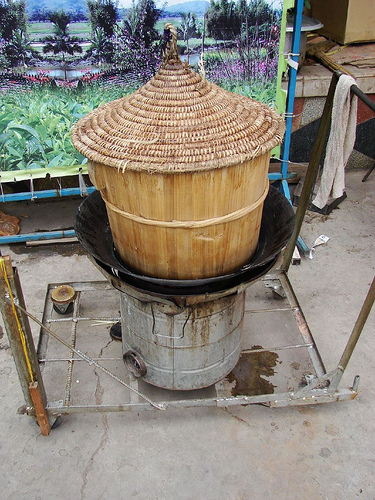
Straw Hats Used as Cooker Covers, hats and cooker covers with bamboo and paddy stems
Straw Hats Used as Cooker Covers
Hardworking and honest countrymen weave everyday necessities, such as shoes, fans, hats, baskets and cooker covers with bamboo and paddy stems. 

     Eighth: Rainy Here but Sunny There

Yunnan possesses a plateau climate as changeable as a kid’s face, since rain and wind come and go without one knowing. A popular saying goes like this, “Weather varies within a circumference of ten lis (Li is a Chinese unit of half a kilometer) and winter comes once it rains.” Even in the same area, one often sees rain here and sees sunshine in another place.

     Ninth: Girls Wear Flowers in all Seasons

Girls Wear Flowers in all Seasons, fresh flowers can be seen in any season
Girls Wear Flowers in all Seasons
The weather is like that of eternal spring in most regions of Yunnan. Kunming, as the capital of the province, has a state of ecstasy as “climate remains like that of February and March, and flowers blossom throughout the year”. There fore, Kunming is named as “Spring City” in China. Fresh flowers can be seen in any season. The floral industry has become the main economic industry in Kunming. 

   Tenth: Non-slanting Walls Built with Cobbles

People draw on local resources to build houses along river banks in the countryside. Cobbles as a building material make walls neat and they create a unique local architecture. 

                                     Eleventh: Green Vegetables Called Bitter Vegetables

Thin green featherlike overlapping vegetables, like vanilla, are grown in the southern part of the province. Its name comes form old old customs but not from its taste.

                                    Twelfth: Bamboo Used as Smoking Pipe

Bamboo Used as Smoking Pipe, is a typical local smoking utensil
Bamboo Used as Smoking Pipe
A smoking bag is also called “tobacco Tube” which is a typical local smoking utensil used mostly in Yunnan, Guizhou and Sichuan provinces It is half to one meter long while its diameter varies from five to ten centimeters. People put cut tobacco on the bamboo tube, the lower part of which is filled with water, and smoked. A gurgling sound is heard when one smokes from the mouth of the bamboo tube. People said brave and struggling “Dian Army” of the past days carried tobacco tubes on their backs to the frontline in the anti-Japanese war. The enemies mistook such smoking tool for a new type of weapon and were horrified. Therefore, “Dian Army” won the name of “Army with Double Guns”. 

                                       Thirteenth: Tea leaves Sold in Piles

The Jinpo minority group in Luxi county of Dehong prefecture, sells tealeaves by piles instead of using scales. 

                                       Fourteenth: The Same Dress for Four Seasons

The weather in most parts of Yunnan is always like that of spring, so the alternation of seasons is not obvious. This means people dress themselves without distinct seasonal characteristics. 

                                       Fifteenth: Girls Hang Tobacco Bags

The Lisu minority girls have a habit of smoking and chewing tobacco, so most married or unmarried females hang tobacco hags on their waist belts. They present bags to one another, with respect on the occasion of union, in order to show kindness and intimacy and it gradually becomes necessary entertainment to their guests. 

                                      Sixteenth: Automobiles Move Faster than Trains

Toes Show Outsides, some people wear straw shoes with holes since the four seasons are mild
Toes Show Outsides
The speed of a train is much slower than that of an automobile on the narrow railways across certain precipitous relieves in Yunnan. 

                                     Seventeenth: Toes Show Outsides

Some people from the mountainous areas wear straw shoes with holes all year round since the four seasons are mild. 

                Eighteenth: Three mosquitoes make up a Dish

There are non-poisonous mosquitoes with long legs in Yunnan. They look so big at the first glance that outsiders say, “three mosquitoes make up a dish” for fun.

--If you have been to Yunnan, please take this passage as a reference to check whether you have occur to some these odds or not; Just amuse and thanks for the funs they have brought to you;

--If you haven’t been to Yunnan yet, please take this as a reminder, once you go to Yunnan, observe things there carefully and enjoy the funs these odds come up to you.

--If you think any line of them is so much interesting: I’m waiting for your sharing here. 

Monday, December 17, 2012

Impression Yunnan V: The Jewel of the Southwest--Dali

In the previous articles in Yunnan series, we talked about the some Yunnan impressions of tourists. In this chapter, we will introduce the jewel of the southwest of Yunnan-Dali, another impression about Yunnan.

                                                                    Chapter Five


              The Jewel of the Southwest--Dali

--Dali is famous for its perfect combination of nature and culture. You’ll be amazed at the sights as Dali’s famous three pagodas reflect off a still lake while mountains rise in the background. Now, are you ready to go with me into Dali?

Located northwest of the Yunnan Province, 300 kilo-meters (186 miles) northwest of Kunming, Dali City is the economic and cultural center of the Dali Bai Autonomous Prefecture. The area is surrounded by mountains on the east, west, and south, and has the Erhai Lake in its center. Here you will find 25 ethnic minorities, which have created a unique cultural heritage amidst the area's picturesque surroundings.

Present Dali is a city that combines history with modern convenience. It is divided into two areas- the Ancient City and the New District. The Ancient City is centered nearby the ancient city of Dali which first built in the Ming Dynasty (1368-1644). Ancient buildings, city walls and the old city moat are the sites most frequented by visitors. 

                                                       Wandering in Dali

Dali is a little present waiting for you after a strenuous journey by road. It offers a lake shore dotted with rustic villages, mountains cut with waterfalls and the relaxed atmosphere of a backpacker’s retreat.
Dali Ancient City, shows the history of Dali
Dali Ancient City

While tourists choke its streets today, centuries before Dali was visited by flocks of foreign invaders, who coveted this little town for its favorable location near the Silk Road. Legend goes that Piluoge, an 8th century prince from Yunnan, invited his rivals to a feast, burnt them alive, then set out to merge six small Dai Kingdoms into the powerful Nanzhao Kingdom. Dali, called Taihe at the time, became capital of this powerful kingdom, which enjoyed hegemony over northern Yunnan and upper Myanmar. From here, the ruler of Nanzhao controlled the east to west trade route to India until the kingdom fell in the 13th century under the attack of the Mongol armies of Kublai Khan. 

Set against the stunning mountain backdrop of Cang Shan in northwest Yunnan Province, lackadaisical Dali holds very little to remind the visitor of its turbulent past. In the revitalized town of Old Dali, a backpacker’s paradise of cappuccinos and pizza joints alternate with traditional shops selling tea, Chinese medicine and handicrafts. The cobbled streets of the old town are filled with the patter of feet as tourists and locals alike take leisurely jaunts through the small town. Be aware that the nearby town of Xiaguan is also called Dali City. Don’t end up in the middle of Xiaguan wondering why the small town has suddenly turned into a midsized gray city.

the New District, Dali is a modern city
the New District of Dali
While a modern brush has touched Dali, this quaint town perched 1,900m above sea level still remains much of its charm. Architecture is often Bai-inspired. The Bais, an ethnic minority forms the majority in Dali as the Han, Hui, Yi and Tibetan ethnic groups. The indigenous Bai community has grown long roots here. They number over a million today. 

Their cultural influences are found in Dali Town, and in surrounding villages, especially around the Erhai Lake region, just east of Dali. Their homes are often two-storey stone and wood abodes, topped by double-tiered roofs with wooden folding doors and ornamental windowpanes. Being artistically inclined, Bais love to decorate their walls with elegant wash paintings. Courtyards are very popular and well-tended. Bai women adore flowers and camellia and bougainvillea plants are a common feature at home. It also gives the Bai women, clothed in ethnic hues, their nickname“Golden Flowers.”

To fully appreciate Bai-style architecture, cuisine, their fragrant tea and distinctive culture, head for Xizhou and Zhoucheng. The Yan, Hou and Zhou Compounds in Xizhou, a photogenic village 20Km north of Dali, are good examples of the Bai flair for architecture and elegant living. 

Bai women are masters of this folk art. Using a special dye called banlangen, the women paint designs of animals and flowers on favric tied with threads. The threads are cut, and these colorful handkerchiefs, blouses, and scarves flutter like flaming banners in the courtyards as they dry in the sun. 

                                                      Cycling around Dali

Several superb natural and cultural sights are outside“old” Dali’s walled city gates. Be adventurous and be ready to move distances. A 10-minute bicycle ride from Dali takes you to the shores of the breathtaking Erhai Lake. 

You can ride around the lake and meander through Xizhou, Zhoucheng and Shaping villages. The isle in the center is rocky Putuo Island, which retains a Buddhist population and the several ruins, including the Lesser Putuo Temple. For a short island trip, hop onto a boat from Caicun dock some 5Km east of Dali and watch trained cormorants with nooses around their necks pick the day’s catch.
Temple of the Three Pagodas, the tallest, called Pagoda of the Thousand Searches
Temple of the Three Pagodas

During your cycling, an obvious landmark is the Temple of the Three Pagodas, situated northwest of Dali. The original structures were built in the 9th century but destroyed by a fire in the 19th century. While being rebuilt in 1978, 600 relics dating from the Nanzhao period were discovered in the pagodas, adding to their prestige. The tallest, called Pagoda of the Thousand Searches, stands 70m high and is comprised of 16 levels, and flanked by two ten-storey octagonal pagodas flank it.

These structures not only store the ashes and bones of saints, scriptures and precious objects, they also invoked Buddha’s protection against natural disasters. The marble stele in front of Pagoda of the Thousand Searches bears the characters“Yong Zhen Shan Chuan” which means,“Forever subdue the mountains and rivers.” Just behind them is the Temple of the Exalted One, which is a museum detailing the history and construction of the pagodas. 

Friday, December 14, 2012

Memory of Shanghai IX: Shanghai Flavor

When we are travelling, besides enjoy the beautiful attractions, I think taste the local delicious snacks is a thing we must to do. In this chapter, we will talk about the Shanghai snacks.

                                                               Chapter Nine

           Shanghai Flavor: A unique flavor for you

There is an old saying that the food of a place can best reflect the local people's favor. How about Shanghai? Without doubt, Shanghai cuisine exposes local flavor. Are you ready to enjoy a food feast in Shanghai?

Shanghai Cuisine, which is not ranked among the four main cuisines of China, has comprised all the favors of the whole ranges of cuisines.

As Shanghai is a miniature of “melting pot” of various cultures and customs, there are only a few native Shanghainese whose grandparents were born in Shanghai. Most Shanghaiese’s grandparents were“immigrants” who came to Shanghai for a new life. They brought to Shanghai their native cooking styles, which enriched and enhanced Shanghai cuisine. 

Thus, it makes Shanghai Cuisine one of the most delicate cuisines in the world. It’s highly appraised by gourmets both at home and abroad. Now, people can entertain themselves with all tastes of cuisines without leaving Shanghai, for all“immigrants” have brought their particular style of cooking to Shanghai.
Shanghai Snacks, comprise dozens of pastries, buns, stuffed dumplings and rice and cakes
Shanghai Snacks

To meet the various demands of visitors from home and abroad, Shanghai has led the country in catering trade. The restaurants in Shanghai not only serve many different regional cuisines, such as Shandong, Sichuan, Guangdong, Huaiyang, Beijing, Zhejiang, Henan, Hunan and Fujian foods, but also provide vegetarian Muslin and other palatable exotic dishes from Europe and East Asia, etc. 

Consequently, defining Shanghai Cuisine is a complicated task. Some say it is a more refined version of the cooking style of neighboring provinces. Others say that it absorbs features of all the culinary schools of China. And still others maintain that it is mere soup buns and red braised chicken.

In fact, the Shanghai Cuisine that evolved tends to be a mix of regional cuisines, with an emphasis on seafood, particularly freshwater fish as well as seasonal vegetables.

Standard Shanghainese dishes like Deep-fried Pork Steak and Fruit Salad reflect the Western influence. Old-style Shanghai food was distinguished by its thick stock, heavy sauce, moderate taste and natural flavors. Adopting local products, Shanghai Cuisine is characterized by its ample use of gravies, oil and brown sauce, which preserves the original flavor of the ingredients.

In particular, Shanghai snacks, which can be traced back to the Southern Song Dynasty, are renowned for their unique flavors. A wide selection of Shanghai snacks comprises dozens of pastries, buns, stuffed dumplings and rice and cakes, which are light, fresh, and tasty, and have long been popular among locals and visitors.
Nanxiang Xiao Long Bao, the fillings are traditionally broth and meat
Nanxiang Xiao Long Bao

Refreshments and snacks from all over China and the world are available in Shanghai. Local snacks in Shanghai have their specialties and should not be missed. The following are some typical Shanghai snacks for your reference--

Xiao Long Bao: Shanghai-style Xiao Long Bao originated in the town of Nanxiang in the suburbs of Shanghai. The buns are traditionally steamed in bamboo baskets. People also give it is an English name – soup dumpling.

The fillings of Xiao Long Bao--the small buns are served hot in the bamboo baskets in which they were steamed, usually on a bed of dried leaves. The buns are usually dipped in Chinkiang vinegar with ginger slivers. Unlike other stuffed buns, or Baozi, found throughout China, the fillings of Xiao Long Bao are traditionally broth and meat, while other fillings are also available. The broth wrapped as the filling is the essence of this food. When you bite a Xiao Long Bao, the broth inside will immediately flows out. The delicious taste will make you become a greediness person who only wants to eat more Xiao Long Bao.
Da Zha Xie, is a special type of crab found in rivers
Da Zha Xie

Da Zha Xie: Da Zha Xie is a special type of crab found in rivers, and is normally consumed in the winter. The crabs are tied with ropes or strings, placed in bamboo containers, steamed and served. There few other artificial ingredients added to the dish yet it tastes fantastically good. Da Zha Xie is usually consumed with vinegar. Locals are also quite fussy about when to consume male crabs and when to consume female crabs.

Smoked Fish Slices: It’s an ideal menu for those who like highly spiced food. the Smoked Fish Slices (fresh fish marinated and spiced to taste like smoked fish) make a delicious, unusual hors doeuvre, while the strong-tasting Stewed Pork Flavoured with Dried Squid dish is offset by the vegetable rice to make a substantial meal.
Crab-Yellow Pastry, it is then wrapped with a layer of sesame and finally baked in an oven
Crab-Yellow Pastry

Crab-Yellow Pastry: this round yellow pastry looks like the shell of a cooked crab, therefore it is named Crab-Yellow Pastry. The main raw material for this snack is oil-mixed dough. The dough is split into small pieces, stuffed and squashed to form a flat round cake. It is then wrapped with a layer of sesame and finally baked in an oven.

The Crab-Yellow Pastry usually has a salty or sweet flavor. The salty pastries are stuffed with shallot oil, pork, crab or shrimp; the sweet ones with sugar, roses, sweetened bean paste or Chinese date paste.

Fried Stuffed Bun: fried Stuffed Bun with nearly 100 years' history is a typical indigenous snack of Shanghai. The wraps of the buns are made of semi-fermented paste, and the stuffing is made of pork, shallot, ginger, soy, pepper, and sesame oil. The stuffed buns are put in rows in a big pan and fried, being sprayed with water several times during cooking. Finally, sesame and shallot are sprinkled on the buns, and then the wonderful Fried Stuffed Buns are prepared.
Fried Stuffed Bun, is a typical indigenous snack of Shanghai
fried Stuffed Bun

With a thin and soft wrap, a golden-colored and crispy bottom, and delicious meat, this snack tastes best when served hot. Fried Stuffed Buns were first served in many teahouses in old Shanghai. Special fried stuffed bun restaurants began to appear in 1930s. At present, there are hundreds of such restaurants. The stuffing is varied to include chicken, crab and shrimp.

Recommended restaurants—

Guang Ming Cun Restaurant: it was opened in 1948, is remarkable for dim-sum and snacks with over ten dishes awarded "Shanghai specialty snacks". Those snacks are highly appreciated including juicy chicken wanton soup, fired crabmeat stuffed bun and steamed pork stuffed bun. Some signature dishes are superb like crystal shrimp, peppery beef filet with honey, crispy duck, turtle and snake soup with herbs, eye brow-shaped crispy cake and milky date. The restaurant is popular with customers for its inexpensive piece, authentic taste, comfortable ambience and excellent service. 

Specialty: juicy chicken wanton soup, fires crab meat stuffed bun 
Lu Bo Lang Restaurant, is well-known by carefully selected raw materials and meticulous preparations
Lu Bo Lang Restaurant

Lu Bo Lang Restaurant: Lu Bo Lang Restaurant, located by nine-twist-bridge at Old City God Temple, has an archaic, elegant and peaceful surrounding matching the elegance of Mid-Pond-Pavilion tea house next door. It is well-known by carefully selected raw materials and meticulous preparations, highly praised by gourmands from home and abroad. The signature dish "osmanthus cake" is so sticky in texture that gets stuck on plate or chopsticks but not tooth and feels smooth in the mouth carrying faint fragrance of rice wine, which puzzled former U.S President Clinton who had practiced with chopsticks for one month. 

Specialty: eye brow-shaped crispy cake, sticky osmanthus cake, eight-treasure duck 

Wu Fang Zhai Dim-sum Restaurant: Wu Fang Zhai Dim-sum Restaurant was established in 1958. The pastries are made with five recipe-made natural herbal fillings, namely, rose, osmanthus, pine, lotus (or mint), hence the name "Wu Fang Zhai" (literally "five fragrance restaurant"). They are varied in seasons such as glutinous rice ball with red bean paste in Pure Brightness Festival, pyramid shaped sticky rice dumpling in bamboo leaves, Double-Nine cake at the festival, eight treasure rice and sweet rice cake in Spring Festival. The "three sweetness", namely sweet taro, sweet potato and sweet rice-filled lotus roots are most sought-after in decades. 

Specialty: glutinous rice dumpling in bamboo leaves, pastries and cakes 

--Shanghai is an ideal place for you to find out delicious food at every corner of its streets. Watering about various Shanghai dishes now? Or you have other recommended Shanghai snakes or good restaurants, please share with me. No doubt, I’m a people fancy of eating delicious tastes. 

Wednesday, December 12, 2012

Worship Tibet III: Mount Qomolangma

Speaking of Tibet, I think the Mount Everest, the highest peak in the world, should be the first attractions you think. We will talked about the Mount Qomolangma in the chapter.

                                                          Chapter Three

                               Mount Qomolangma

Mt. Everest, also known as Mt. Qomolangma, located at the border between China and Nepal, its North Slope belongs to China and south belongs to Nepal. It means Goddess Third in Tibet, is the highest peak in the world. 
Mt. Qomolangma, it means Goddess Third in Tibet
Mt. Qomolangma
The altitude of Mt. Everest is now about 8,844.43 m. (29,017 ft.). It is the dominant peak of Himalayas, the northern brae in Tingri County of Tibet and the southern in the Nepal. The area has 4 peaks above 8,000 m. (26,247 ft.) and 38 peaks above 7,000 m. (22,965 ft.), hence the laudatory title 'the Third Pole of the Earth'.
As the supreme point of the world, Mt. Everest is also blessed with many extreme wonders. The top part of the mountain is covered with snow all the year round. When the glaring sun shines on the mountain, the peak is just like a white pyramid miraculously transformed by the Goddess, leading us to imagine her semblance further. 
More often than not, the thick freely moving clouds and fogs, seeming as if a flag with the mast of the peak was swinging, will shroud the peak. This peculiar phenomenon of Mt. Everest is known as 'Flag Cloud'. An additional wonder generated here are the bright glaciers, where ices are formed into various shapes like bridges, pagodas and others.
You can also find miles of efflorescent rock physiognomy there, such as stalagmites, stelae, stone sword, and stone pagodas. The climbing pathfinders call this splendor at such high attitude 'the Largest Park on the High Mountain'.
The peak has been a holy climbing attraction for world's mountaineers. In recent years, more and more mountaineers start from the Everest Base Camp trying to conquer the world's highest peak while tourists trek to the foot of the peak to enjoy its beauty. 

Travel Tips for Mt. Qomolangma:

Mt. Everest, is the highest peak in the world
Mt. Everest
(1) Exploration of Mt. Everest is not suitable from October to April in the following year because of the chill weather; and it is monsoon in July and August, when it is impossible to see the Mt.Everest in the misty rain. So it’s the best time to enjoy Mt.Everest in April, May and June.
(2) You need to issue a travel permit before you go to Mt.Everest Camp, Zhangmu Port or Ali. It may delay you if you issue the travel permit in Lhasa. So it’s better for you to issue it at the local Police Office before you come to Tibet. The issuing procedure is quite simple and only cost RMB 2 Yuan. You can get it immediately. 
For the destination on the travel permit, you may have to fill it in like this. If you want to go to Mt.Everest you need to fill in the blank on the travel permit with Tingri County, Zhangmu Port with Nyalam County. You can also check it at the Police Office, which have map and detail information of the national boarder. 
Mount Qomolangma, is located in the Mahalangur section of the Himalayas
Mount Qomolangma
If you have passport and valid visa to Nepal, then you don’t need any travel permit to go to Mt.Everest or Zhangmu. However, if you want to go to Tsaparang to visit Googe Dynasty it won’t work, you still need travel permit unless you have the valid visa to India or Pakistan.
(3) It is recommended to take picture of Mt.Everest afterglow after you check in at Rongbuk Monastery. Rongbuk Monastery is also a good place for overlooking Mt.Everest. There are only 25 kilometers straightaway between these tow places. 
From Rongbuk Monastery, take a 15 mins’ car or 2 hs’ walk across valley, cliff and odd rocks, and finally you will arrive at Qomolangma Base Camp enjoying the most beautiful view at the dawn or evening fall. The Admission Fee here is RMB 20 Yuan per one. There are about 3 or hours car drive away from here to Serac Groups-Serac World.
(4) You’d better wear anti-slip; endurable, cling-ground sports shoes with dentate tread.